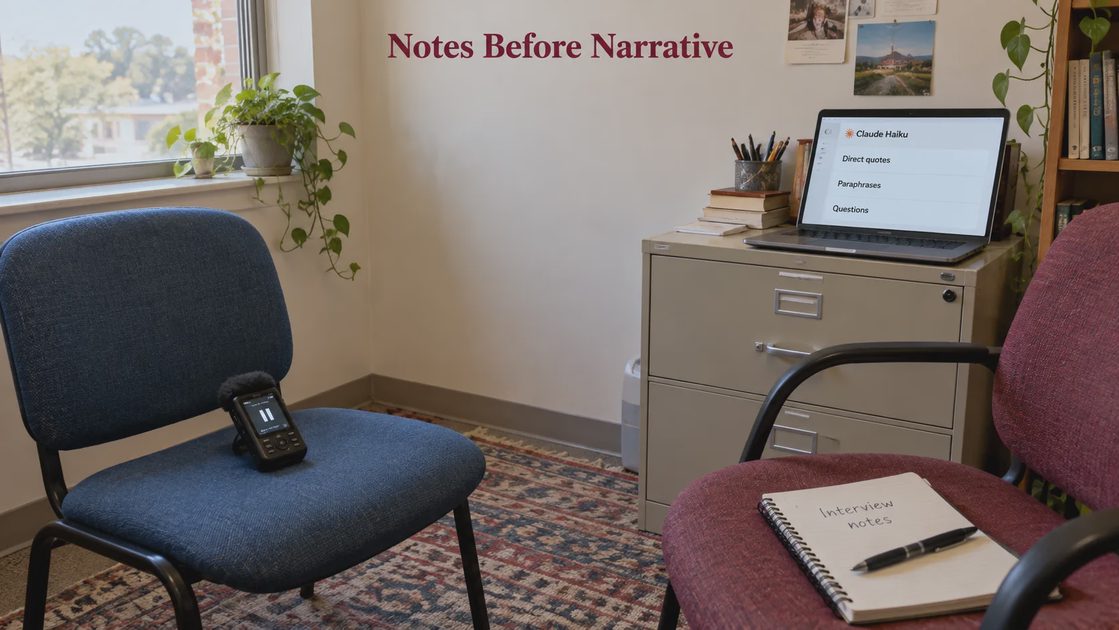
Claude can help a content team organize interview notes, but the first useful output is often an evidence outline rather than an article. Separate direct quotations, paraphrases, observations, and unanswered questions before asking for a draft.
That separation protects attribution and makes review easier. A polished paragraph can otherwise blend several speakers, convert a paraphrase into a quotation, or fill a gap with something nobody said.
This workflow uses illustrative instructions and assumes the team has permission to use the material. It does not describe a completed client project or report measured drafting savings.
Keep the Speaker’s Meaning Ahead of Smooth Prose
My work at a small education company includes making material clearer, and I prefer short instructions to elaborate prompt systems. The useful request is specific: say who the material is for, what form the draft needs, and what must remain uncertain.
That preference shapes this interview workflow. “Write a compelling article” leaves too much open. “Organize these attributed notes, preserve exact quotations, and flag missing evidence” gives the editor something to inspect before prose hides the gaps.
This guide does not claim a completed interview project from my experience file. Its worked examples demonstrate a method. The distinction matters because an interview article needs the speaker’s actual words and permission, not details supplied by the editor’s imagination. A first draft should make those responsibilities easier to carry out.
Establish the Editorial Brief
Define the article’s audience, purpose, scope, and intended conclusion before providing notes. Do not ask the model to discover the story solely from whatever happens to be easiest to summarize.
A brief might explain that the article should show how a small education team prepares a course handout, with attention to the decision points and remaining work. It should not promise outcomes the interview does not establish.
Also specify attribution rules. Are speakers named, identified by role, or anonymized? Which details are approved for publication? Those decisions belong to the editor and interview subject, not the model.
In editorial coordination, I would treat this brief as the shared boundary between the person who conducted the interview and the person drafting from it. AI does not remove the need for that agreement.
Prepare the Notes Without Erasing Their Limits
Label the source material by interview and speaker. Preserve markers showing uncertainty or incomplete transcription.
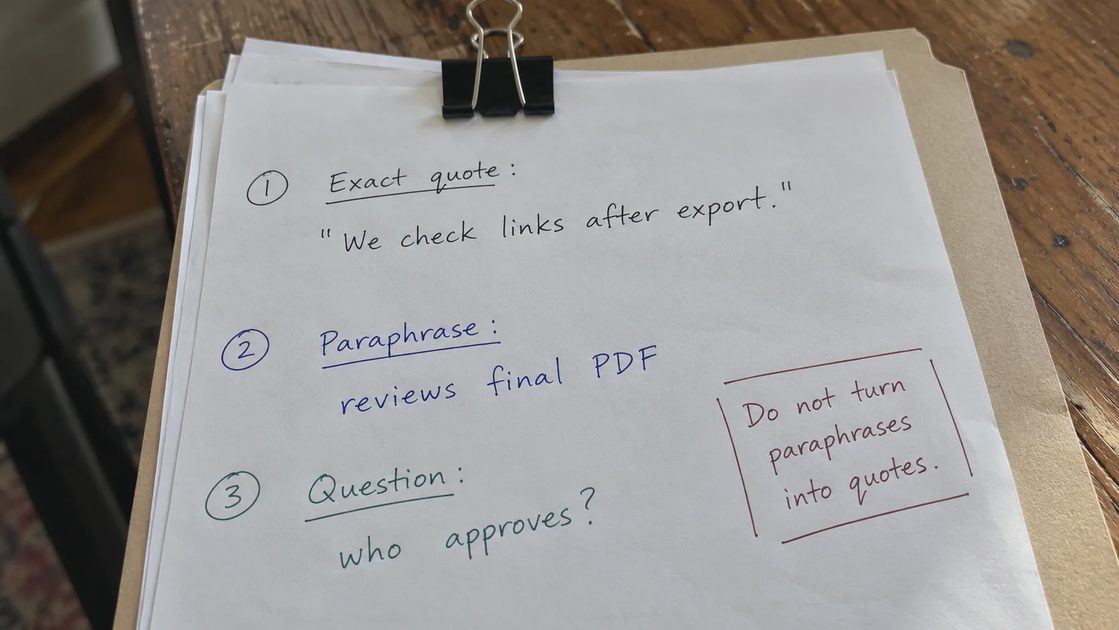
Do not clean rough notes into apparent verbatim statements. If a note is a paraphrase, identify it as a paraphrase. If a quotation has not been checked against the recording or approved transcript, mark it as unverified.
A small source register might include:
Note type | Allowed drafting use |
|---|---|
Verified quotation | Can be quoted under the approved attribution rules |
Paraphrase | Can inform prose without quotation marks |
Interviewer observation | Must be attributed or framed as observation |
Unclear note | Requires clarification before factual use |
Off-record material | Excluded according to the agreed restriction |
The table is a proposed editorial control, not a replacement for your organization’s consent and publication procedures.
Remove material that should not be shared with the model. Permission to interview someone is not automatically permission to send every detail into every tool.
Ask for an Evidence Outline
Begin with structure and support rather than prose:
Create an evidence outline for the supplied editorial brief.
Use only the interview notes provided.

For each proposed section, include:
- The point it would make
- Supporting note IDs
- Whether the support is quotation, paraphrase, or observation
- Missing information or contradictions

Do not write the article yet.
Do not turn paraphrases into quotations.
Do not invent experiences, results, transitions presented as facts,
or statements from the interview subject.
The outline should reveal whether the material supports the intended article. A section with no evidence may need another interview question or removal.
Compare the model’s proposed story with the brief. A fluent narrative can overemphasize a colorful detail while neglecting the central decision the reader needs to understand.
Resolve Gaps Before Drafting Around Them
Suppose the notes say the team changed its review process, but do not establish why. Do not let the draft invent a turning point to make the story satisfying.
Record a follow-up question: What problem prompted the change? What steps changed? Who approved it? What evidence shows the result?
Likewise, an interviewee’s estimate should not become a measured number without supporting records. Preserve whether the statement is an estimate, opinion, or verified observation.
If you cannot obtain the missing information, narrow the article. It can describe the process without claiming a performance improvement. Editorial restraint can produce a more useful account than an unsupported success story.
Draft From the Approved Outline
After reviewing the outline, ask Claude for prose that follows the approved evidence boundaries.
Write a first draft from this approved outline.
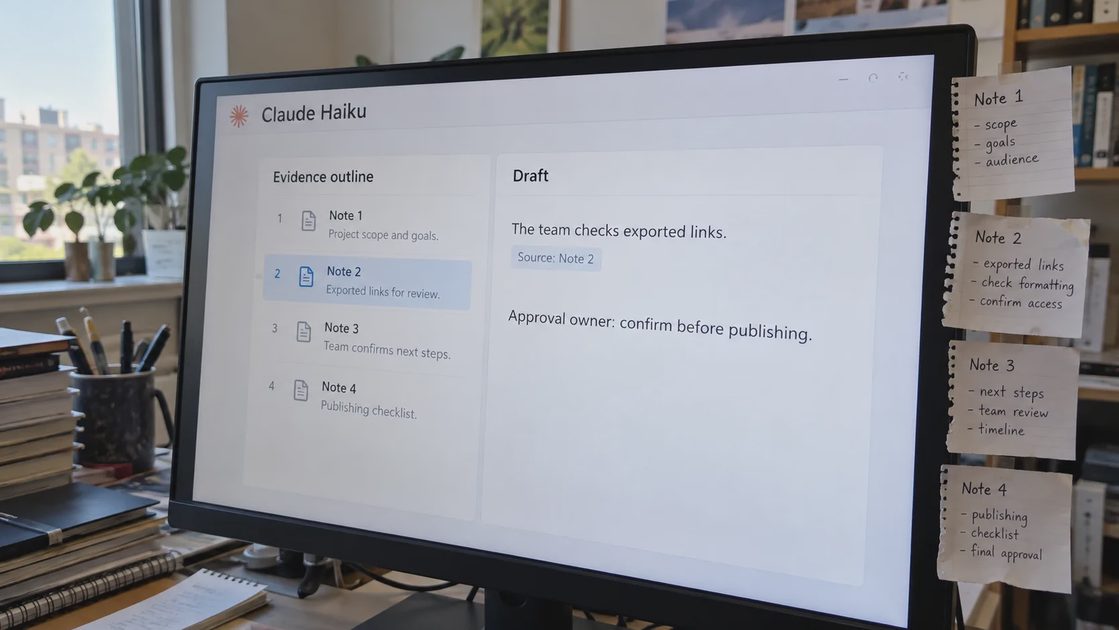
Keep note IDs beside factual claims for internal review.
Use only verified quotations inside quotation marks.
Label unresolved gaps in editorial comments rather than filling them.
Do not claim causation or measured improvement unless the notes support it.
Follow the audience, scope, and tone in the brief.
The internal note IDs can be removed from public copy after verification and replaced with appropriate public attribution where needed. Do not remove them before the editor has completed the source check.
A first draft should leave the team with decisions to review, not conceal those decisions in smooth writing.
Review Attribution Before Style
Read the draft alongside the notes. Check who said each claim, whether the wording is supported, and whether quotations are exact.
Pay attention to merged statements. Two speakers describing different situations should not become one composite first-person story unless the publication clearly explains the construction and it is appropriate to use.
Also check implied experience. A phrase such as “we discovered” can suggest an observed result even when the source only proposes an idea.
I would complete this attribution pass before polishing the introduction. Improving the style of unsupported prose makes it harder to notice that the underlying claim needs repair.
Preserve the Human Judgment in the Story
The article should explain choices, alternatives, and constraints when the notes support them. Ask what the team considered, what was rejected, and what remains difficult.
These details can create useful differentiation without inventing drama. An honest description of why a process uses manual review may teach more than an inflated story about transformation.
If the draft sounds generic, inspect the evidence rather than simply asking for more personality. Specificity should come from actual decisions and details, not invented anecdotes.
You can ask the model to identify sections that repeat common advice without using the supplied notes. Then decide whether to add verified material or cut the section.
Finish With Two Separate Review Passes
The factual pass checks sources, attribution, numbers, and publication permission. The editorial pass checks readability, organization, repetition, and reader usefulness.
Separating them helps prevent a style edit from being mistaken for factual approval. After substantial edits, recheck any changed factual sentences.
Before publication, remove internal comments and verify that unresolved gaps were resolved or omitted. Check the final exported or published version, not only the working draft.
If the subject is entitled to review according to your agreement, follow that process. Do not imply that model drafting changes the agreed approval requirements.
When I Would Use This—and When I Would Not
I would use Claude for evidence outlines and bounded first drafts when the team has permission to share the notes and can inspect every important claim.
I would not use it to fabricate a person’s experience, turn rough paraphrases into quotes, or write a success story unsupported by the interview.
No letters yet — be the first to write.