
Choose a model for a defined task, not for its position on a general leaderboard. A fast, lower-cost model can be a sensible candidate for bounded extraction, classification, and drafts that are easy to check. More difficult reasoning or tool use may justify evaluating a more capable model.
The decision should consider the cost of a correct completed task, including review, retries, integration, and failures. A cheaper response is not automatically a cheaper workflow.
This article offers an evaluation framework for a lean SaaS team. It does not report a production deployment or establish that one model is best for your workload.
Why My Preference for Haiku Is Task-Specific
For short course outlines, household notes, and repeated wording changes, I prefer a tool that responds quickly enough to keep the task moving. Low usage cost also makes it easier to try another draft without treating every revision as an expensive decision.
That preference is not a recommendation to route every SaaS task to the smallest model. Our learner-support work shows why: a routine instruction and a sensitive refund complaint have different requirements, even if both arrive as short messages.
A model upgrade also cannot repair an outdated policy supplied as current evidence. Identify the cause of the difficulty before paying for another tier. Compare the approved result, the reviewer’s effort, and the task boundary. The useful question is whether additional capability improves this particular workflow enough to justify its complete cost.
Start With the Task Boundary
Write down exactly what the model may do and what it must not do. “Support automation” is too broad to compare meaningfully. “Classify this request using five approved categories without replying to the customer” is a clearer unit.
For content work, distinguish organizing notes from publishing a complete article. For internal knowledge, distinguish finding a relevant policy passage from deciding whether an exception should be granted.
A bounded task can make errors easier to inspect and a comparison easier to interpret. It also reveals whether a model is needed at all.
I would want a small team to define the approved output before selecting the model. Otherwise, an impressive answer can shift the goal during the evaluation.
Identify What Makes the Task Difficult
Difficulty is not simply input length. A short message can contain ambiguous intent, competing rules, or an unusual exception. A longer document may ask for a straightforward extraction.
Look for factors such as multiple constraints, conflicting sources, long chains of dependent decisions, unfamiliar formats, and consequences that are hard to reverse.
Task feature | Evaluation implication |
|---|---|
Clear categories and short messages | A fast model is a reasonable candidate to test |
Exact extraction from a stable source | Check completeness and source fidelity |
Ambiguous requests and exceptions | Test abstention and escalation behavior |
Complex dependent tool actions | Evaluate capability and controls separately |
Consequential recommendations | Require appropriate sources and human expertise |
These are testing directions, not universal assignments. The actual result depends on the task, model version, prompt, and surrounding system.
Understand What Haiku’s Positioning Establishes
Anthropic’s Haiku 5.5 announcement positions it for high-volume, cost-sensitive work and describes narrowly scoped uses such as summarization and subagent work. The announcement also distinguishes more complex agentic coding tasks where its larger models remain better choices. Official announcement.
That information can guide which candidates to evaluate. It does not establish performance on your customers’ messages or your internal documents.
Vendor benchmarks and testimonials describe particular evaluations. Treat them as context rather than a replacement for a representative pilot.
Record the model identifier and relevant settings in your own evaluation. A product name without version information can make later comparisons ambiguous.
Compare Complete Workflow Cost

Separate model usage from labor and infrastructure. A basic cost model can include input and output usage, retries, reviewer time, integration work, and maintenance.
Do not combine these into a precise figure unless you have measured the components. At the planning stage, a checklist of cost categories is more honest than an invented savings calculation.
For example, a model with a lower usage bill may produce drafts that require longer policy review. Another model may reduce corrections but still need the same final authorization. The difference must be observed for your task.
A static template or deterministic rule can be the baseline when the task is simple. The comparison is not always between two models.
Run a Representative Comparison
Use the same approved input set and acceptance criteria for each candidate. Include routine cases, ambiguous cases, out-of-scope requests, and the exceptions the team actually handles.
Keep prompt changes controlled. If you substantially optimize one model’s prompt while leaving another with a vague instruction, the result measures different workflows rather than an isolated model difference.
That can still be a useful comparison, but report it honestly. The business needs the best practical workflow, not necessarily a pure model benchmark.
Have reviewers assess important failures and corrections. Where practical, hide the model name during review to reduce expectations influencing the judgment.
Define the Acceptance Criteria Before Testing
A support draft might need to preserve the request, use current policy, avoid unsupported promises, and identify when escalation is required. An extraction might need to include every required field and flag missing ones.
Set criteria according to the consequences. A small stylistic problem differs from a wrong account instruction or an omitted condition.
Do not invent a universal pass rate. Decide which errors are tolerable, which require review, and which stop the workflow.
Also define how the team will handle failures. A model selection is incomplete if there is no safe route when an input cannot be processed reliably.
Consider a Two-Stage Workflow Carefully
A fast model can potentially perform a narrow first stage, while a person or another model handles difficult cases. That is an architecture to evaluate, not a guarantee that escalation will work.
The first stage must identify when it should escalate. If it incorrectly treats a difficult case as routine, the stronger second stage may never see it.
Test the routing decision as well as the downstream answer. Record how often the workflow escalates unnecessarily and how often it fails to escalate when the rules require it.
Avoid adding stages without a clear benefit. A small team may find that one reviewed model or a manual exception path is easier to maintain.
Keep Human Review Independent of Model Tier
A more capable model can still produce unsupported claims. Do not remove review solely because you paid more for the response or selected a larger model.
For consequential work, the right next step may be authoritative source verification or a qualified person, rather than another model call.
I would treat model tier as one tool-selection decision inside a larger process. The source quality, task boundary, permissions, and review method can matter just as much.
If the workflow cannot make important errors visible, reconsider its design before debating token prices.
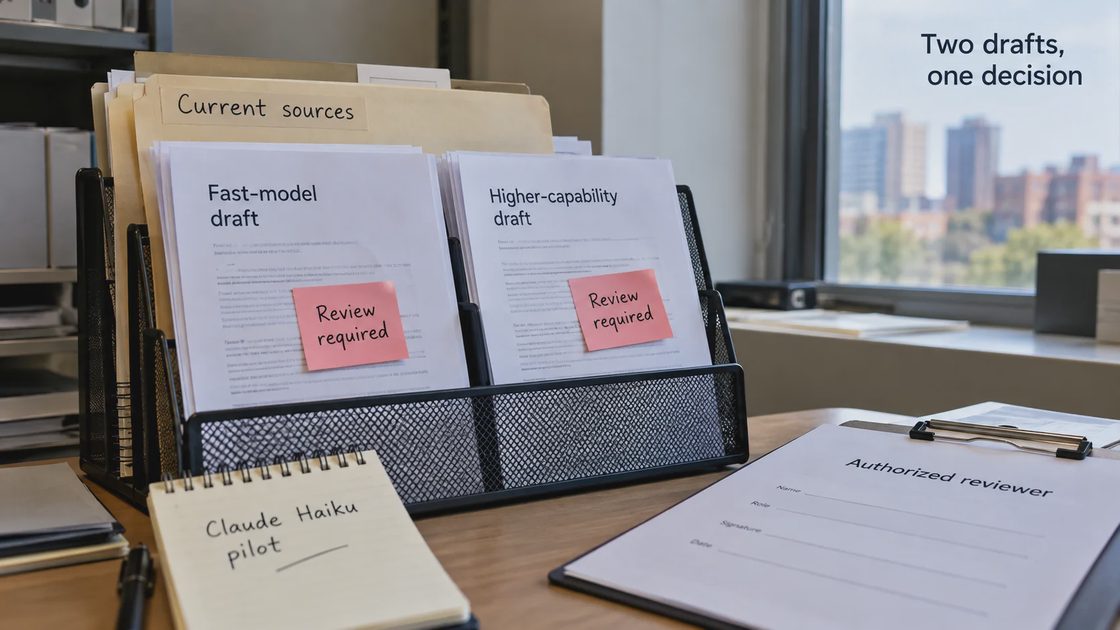
Decide Whether the Difference Matters Operationally
At the end of the pilot, compare accepted outputs, consequential failures, correction effort, latency where relevant, and maintenance burden. Explain the input set and limitations.
A modest improvement may matter at high volume but be irrelevant for occasional work. Conversely, a rare costly failure can outweigh a small average gain.
Do not claim that a short pilot proves long-term reliability. Set a review point and retest after important model, policy, or input changes.
Maintain a manual fallback the team understands. A model decision should not leave the business unable to complete routine work when the system is unavailable.
When I Would Use This—and When I Would Not
I would begin by evaluating Haiku on narrow, reviewable tasks where speed or usage cost is a meaningful constraint. I would evaluate stronger candidates when the task’s difficulty and observed corrections justify it.
I would not select solely from a benchmark score, remove review because a model is larger, or promise savings before measuring the complete process.
No letters yet — be the first to write.