“Good enough” needs a definition before you evaluate Claude Haiku 5.5. Start with the required output, unacceptable errors, and review process, then compare the complete workflow with a reasonable alternative.
Speed, usage cost, and quality are related but distinct. A fast answer can require extensive correction. A cheap model call can sit inside an expensive process. A high-quality draft may still be unsuitable for an action that requires authorization.
This article offers an evaluation worksheet and decision method. It contains no completed benchmark, model score, or measured savings claim.
Fast Enough to Distract From the Actual Goal
Haiku sometimes finishes a long response before I have fully decided what I wanted from it. The speed can make a draft feel like a finished answer, even when I only needed a starting point. I now pause and check whether the response addresses the task I meant to give it.
My private preference for a draft arriving within a couple of seconds is a working expectation, not a universal performance threshold. Network conditions, task size, and the requested output can change the wait.
The more useful threshold is whether the complete process leaves less work to do. A quick draft that needs extensive repair can lose to a familiar template. The framework below therefore measures preparation, review, correction, and handoff alongside response time, with important errors treated separately from cosmetic edits.
Define the Unit You Are Evaluating
Choose a bounded task, such as extracting action items from a short note or drafting a reply from an approved policy. Avoid evaluating “AI productivity” as a single activity.
Describe the input, permitted sources, requested output, and person responsible for approval. Also specify what the model may not do.
The unit should end at the point where the task is actually complete. If the output must be reviewed and moved into another tool, those stages belong in the evaluation.
For ordinary work, I would start with a process whose outcome is visible. It is easier to learn from a checked action list than from a broad promise to improve team efficiency.
Write an Acceptance Statement
An acceptance statement describes what a usable result must satisfy. For a task-list example:
The approved output includes every stated commitment, preserves deadlines, identifies explicit dependencies, and flags missing dates without inventing them.
For a support draft, the statement would need different criteria, including policy fidelity and authorized commitments.
Do not reduce acceptance to “sounds good” or “the reviewer likes it.” Those judgments can contribute to an editorial review, but they do not establish whether the task’s factual requirements were met.
Keep the statement short enough that reviewers can actually apply it. Add detail where consequences justify it.
Separate Error Types by Consequence
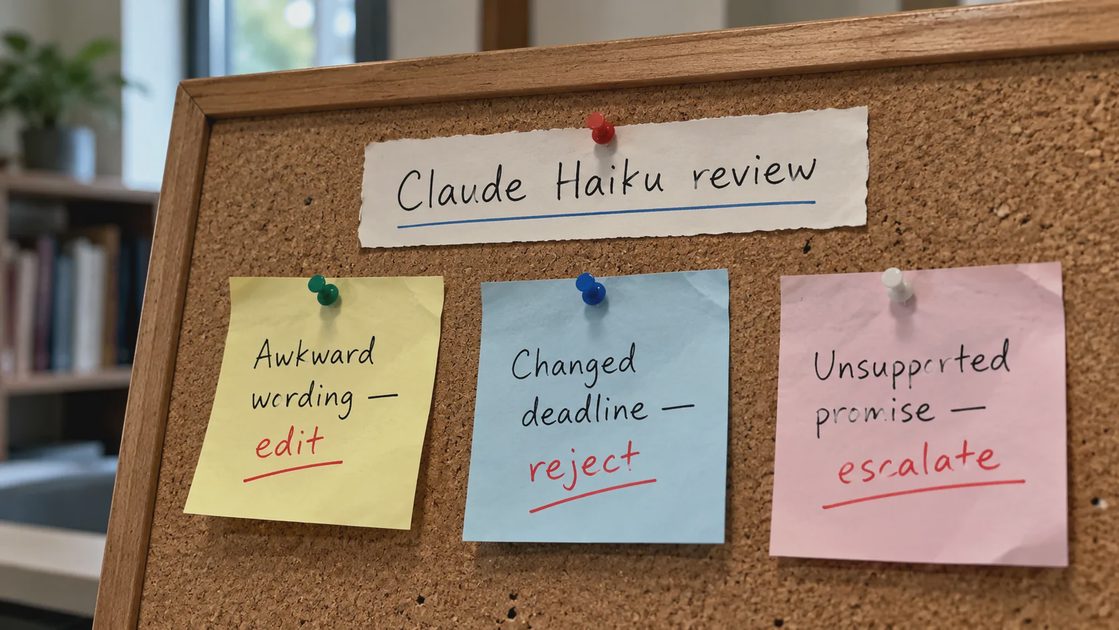
Not all corrections matter equally. A wording improvement differs from a changed date, omitted exception, or unauthorized promise.
Error class | Example | Evaluation treatment |
|---|---|---|
Presentation | Awkward wording | Record editing effort |
Source fidelity | Changed date or missing condition | Require substantive correction |
Scope | Added information outside approved sources | Inspect or remove the addition |
Authorization | Promised an unapproved action | Reject or escalate under policy |
Uncertainty handling | Guessed a missing detail | Correct and examine the boundary |
These categories are illustrative. Your task may require others, and your organization decides which errors are unacceptable.
Do not hide a consequential error inside an average score. The report should make the type of failure visible.
Design an Input Set That Resembles the Work
Include routine examples, unclear cases, missing information, and relevant exceptions. Record how the set was selected.
A handpicked collection of clean inputs can help develop the prompt but should not be described as representative of an entire workload.
Use authorized, appropriately protected material. Fictional examples are useful for method development; label them and recognize that they may not capture the complexity of live work.
If you compare workflows, give them the same source material and acceptance criteria. Record changes in instructions so the comparison remains interpretable.

Keep a Practical Run Log
The log should capture enough information to explain a result later:
Task ID and source version.
Model identifier and date.
Prompt and relevant settings.
Output or retained output reference.
Acceptance outcome and correction type.
Review and repair effort, where measured.
Final disposition: use, revise, reject, or escalate.
Avoid collecting unnecessary personal information in the log. A testing record should not become an uncontrolled copy of customer or student data.
If you rerun a task, retain the first attempt and label subsequent attempts. Otherwise, the log can silently become a collection of best cases.
Measure Complete Effort Honestly
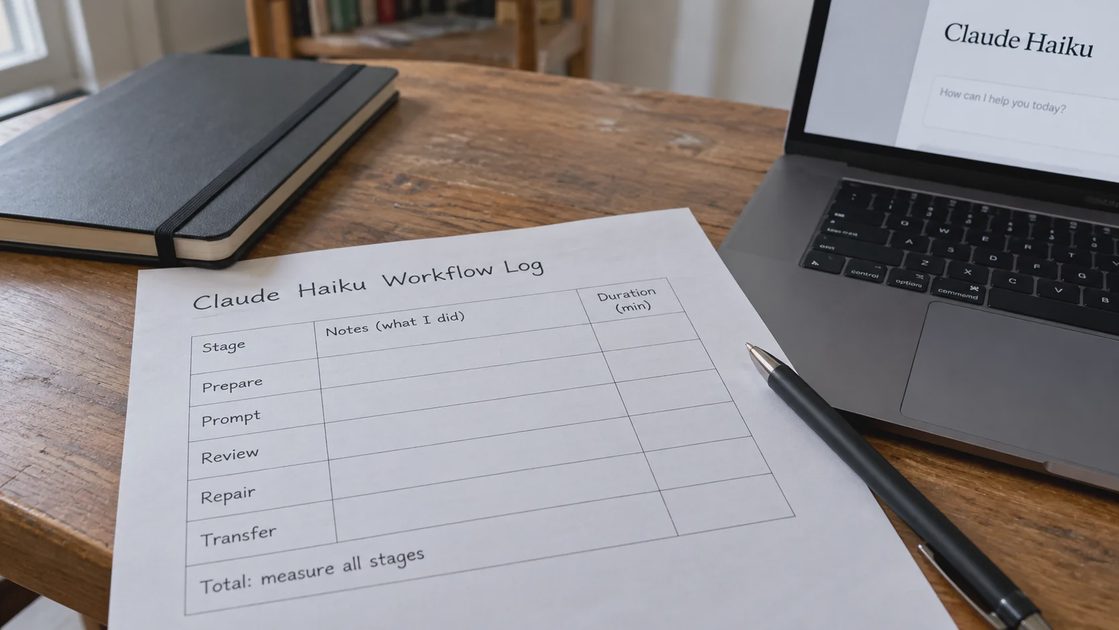
Choose whether to measure active work, elapsed time, or both. Explain the choice, especially when ordinary interruptions are part of the setting.
Include preparation and review. If you spend time sanitizing an input or checking a source, that is part of the workflow even though it occurs outside the model interface.
For a manual baseline, use a reasonable existing process. A badly organized manual method can exaggerate the apparent value of an AI workflow.
If timing is too inconsistent to interpret, report the observed steps and correction burden rather than force a precise savings number.
Treat API Cost as One Component
Anthropic’s launch announcement lists Haiku 5.5 input and output token prices, with different rates depending on prompt length. Consult the current official pricing when estimating a specific workload. Official pricing in the announcement.
Token usage, retries, additional tools, and human work can all affect cost. An API rate is not a complete budget or the price of a chat subscription.
For occasional individual use, workflow complexity may matter more than a small difference in model usage. At larger volume, usage cost can become more significant, but correction effort still belongs in the calculation.
Do not report a monthly projection without explaining the assumptions behind volume and usage.
Test Repeatability and Changed Conditions
Repeat selected inputs to examine consistency. Vary inputs to examine how the workflow handles different cases. Change only what you intend to study where practical.
A new source format, different terminology, or an ambiguous date can reveal a boundary that clean examples did not expose.
Retest after important changes in model version, prompt, policy, or source material. A previous result applies to the conditions recorded, not indefinitely to every future version.
A small evaluation cannot eliminate uncertainty. Its job is to make the uncertainty specific enough for a sensible decision.
Make an Adoption Decision With Limits
Possible decisions include adopt for reviewed drafts, narrow the task, revise the source material, evaluate another candidate, or keep the manual process.
Specify the boundary of any adoption. For example, a team might approve source-based internal drafts while keeping customer-facing sending entirely manual.
Do not let a successful extraction task justify a separate action-taking workflow that has not been evaluated. Each new permission or consequence changes the decision.
I would prefer a narrow, explainable adoption to a broad system that nobody can inspect. The workflow should remain reversible and have an owner for updates.
Keep an Exit Route
Document how work continues if the model route is unavailable or the pilot stops. The approved source material and manual procedure should remain accessible. A workflow that cannot be paused without losing the underlying task information has a maintenance problem that a better benchmark score will not solve.
When I Would Use This—and When I Would Not
I would use this framework when a task is repeatable and someone needs to decide whether Haiku is worth integrating into it. It provides a way to connect quality, review effort, and practical cost.
I would not use it to manufacture a universal model ranking, guarantee future reliability, or report results that have not been observed.

No letters yet — be the first to write.