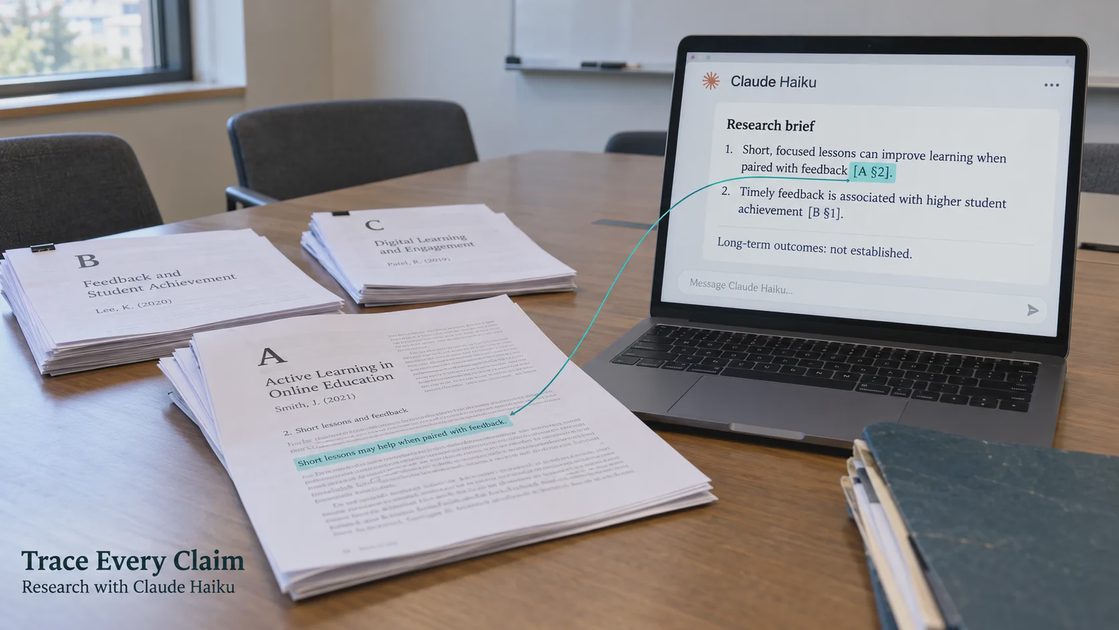
A source-based research brief should make its important claims easy to trace. Give Claude a defined question and a labeled source set, ask it to extract evidence before drafting, and review the resulting claims against the actual passages.
The model can help organize material and produce a draft. It cannot make a weak source authoritative, resolve a disagreement by sounding confident, or establish that a citation supports a claim merely by placing them together.
The Plausible Number That Changed My Method
I once asked Haiku to check a historical number in an education paper. It returned a convincing-looking figure that was invented. The response sounded like verification, but it had not provided evidence I could rely on.
That is the reason for the source register and claim table in this workflow. Every important assertion needs a passage to inspect, not just a polished sentence or a citation-shaped label. If the supplied sources do not establish the number, the draft should leave it unresolved.
For a research brief, treat uncertainty as useful output. “These sources do not answer the question” can tell the team what to research next. Filling the gap would make the document longer while making the decision less informed. The sample prompts below organize available evidence; they do not make the evidence stronger.
Define the Decision the Brief Supports
Begin with a question narrow enough for the available material. “Tell me about online learning” is broad; “What do these three sources say about the constraints of short self-paced lessons?” is easier to inspect.
Specify the reader and intended use. A background note may tolerate open questions; a recommendation to change a program needs clearer evidence and explicit limits.
Also define what is outside scope. If your sources do not address costs or long-term outcomes, the brief should not invent those sections to look comprehensive.
For my work, I would begin by deciding what someone needs to understand or choose after reading the brief. That keeps the document from becoming a collection of interesting facts without a practical purpose.
Build a Source Register
Create a small register before supplying the material. Use stable labels and retain the original links or documents.
Field | Why it matters |
|---|---|
Source ID | Gives each claim a stable reference |
Title and author or organization | Identifies who produced the material |
Publication or update date | Helps assess whether the information is current |
Source type | Distinguishes research, policy, commentary, and vendor material |
Relevant section | Shows which part addresses your question |
Known limitation | Records missing context or restricted applicability |
Do not ask the model to fill missing bibliographic details from memory. Check them from the source or leave them unresolved.
A vendor page can provide product information but should be identified as vendor material. An opinion piece can contribute an interpretation without becoming evidence of an outcome.
Extract Evidence Before Writing Prose
Ask Claude to produce an evidence table using only the supplied sources. This separates source inspection from the pressure to create a smooth narrative.
Use only Sources A, B, and C supplied below.
For the question [question], extract relevant claims.

Return a table with:
- Claim
- Source ID
- Supporting passage or section
- Conditions or limitations
- Whether the claim is directly stated or inferred

Do not write the brief yet.
Do not invent missing citations or bibliographic details.
Flag disagreements and unsupported questions.
A source reference must be specific enough that you can find the support. “Source A says this” is weaker than a heading and a short passage that actually expresses the claim.
If the source set is large, process it in manageable groups and preserve the source IDs. Combining several extraction tables can create duplicate or conflicting claims; review the merged table before drafting.
Check the Evidence Table Yourself
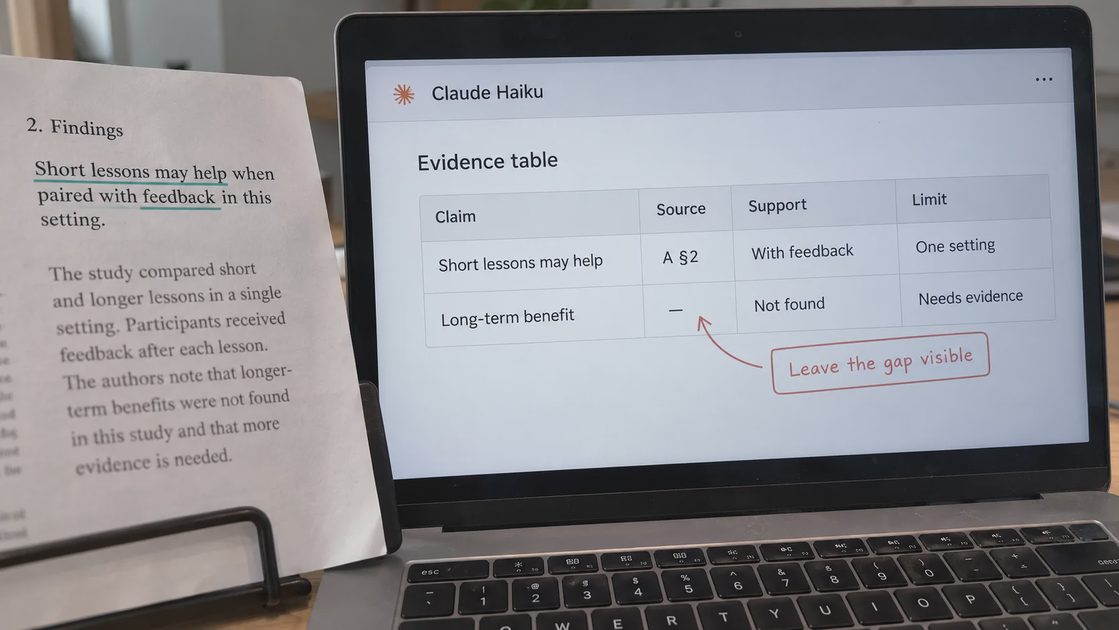
Inspect the important rows against the original material. Confirm that the passage says what the claim says, that the context is preserved, and that the source is relevant to the brief’s question.
Look particularly for changes in certainty. “May help” is different from “improves,” and an observation in one setting is different from a general recommendation.
Also inspect unsupported inferences. An inference may be reasonable, but it must remain labeled and supported by an explanation of how it follows from the evidence.
If a source conflicts with another, keep the disagreement visible. It may reflect different populations, definitions, dates, or methods. Do not ask Claude to average incompatible conclusions into a confident middle position.
Draft From Approved Claims
Once the evidence table is reviewed, ask for a brief that uses the approved rows and the original purpose.
Draft a research brief from the approved evidence table.

Structure:
- Question and scope
- What the sources support
- Where they disagree or leave uncertainty
- Implications for the stated decision
- Questions requiring more evidence

Keep source IDs beside factual claims.
Label editorial recommendations separately from source findings.
Do not add claims beyond the approved table.
This instruction sets a boundary; it does not guarantee the draft stays within it. Compare the brief with the approved table after generation.
A short brief can be more useful than an exhaustive one. Retain the qualifications that affect the decision, and remove background that does not serve the stated purpose.
Separate Findings From Recommendations
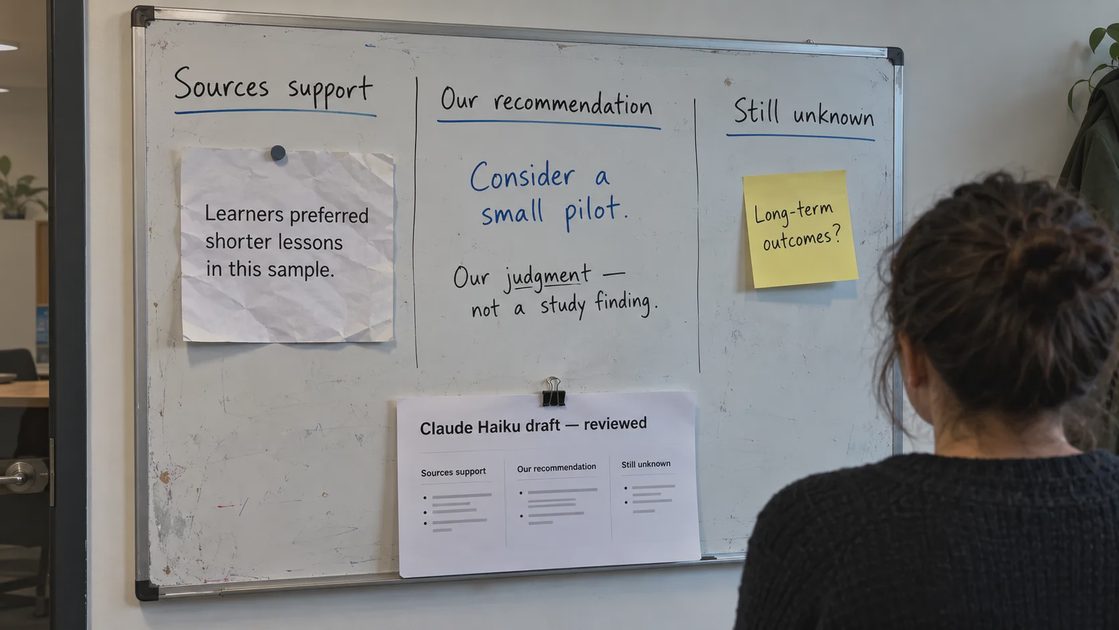
Readers should be able to tell which sentences summarize sources and which express your judgment about what to do.
For example, a source may state that learners in its study preferred shorter lessons. A recommendation to shorten your organization’s lessons requires additional reasoning about your audience, objectives, and constraints.
That recommendation should not be presented as a direct finding of the source. Label the decision logic and identify what remains uncertain.
I would use a phrase such as “For this proposed pilot, the evidence suggests considering…” only when the evidence genuinely supports the consideration. The cautious wording does not excuse a missing connection.
A source-backed paragraph needs both support and a fair representation of its limits.
Make Verification Practical for the Reader
Keep citations close to claims and use descriptive source labels. Do not put every reference at the end of a long document without showing which claim it supports.
For an internal brief, a linked evidence appendix can be useful. For a public article, cite accessible sources and explain any limitation on what the reader can inspect.
A table of claims is especially helpful when the brief will be updated. If a source changes, you can identify the affected statements rather than reread the whole draft looking for hidden dependencies.
Keep the final version and the source register together. A brief separated from its source history is harder to maintain and review.
Handle Missing Evidence Without Filling the Gap
Sometimes the honest result is that the available sources cannot answer the question. State what they support and what additional evidence would be needed.
A model may offer a plausible explanation for the missing piece. Treat that as a suggestion to investigate, not as evidence that the gap has been resolved.
If you add a source, repeat the extraction and verification steps for the new material. Do not paste it into the final paragraph and assume it supports an existing conclusion.
For unfamiliar technical or consequential topics, obtain appropriate review. A traceable citation does not by itself establish that the source is sound or the recommendation is suitable.
When I Would Use This—and When I Would Not
I would use Claude to organize a small source set, identify candidate claims, and draft from a verified evidence table. The workflow is strongest when the question is narrow and the source passages remain accessible.
I would not let it invent citations, convert vendor claims into independent findings, or write a recommendation whose reasoning I cannot explain.

No letters yet — be the first to write.