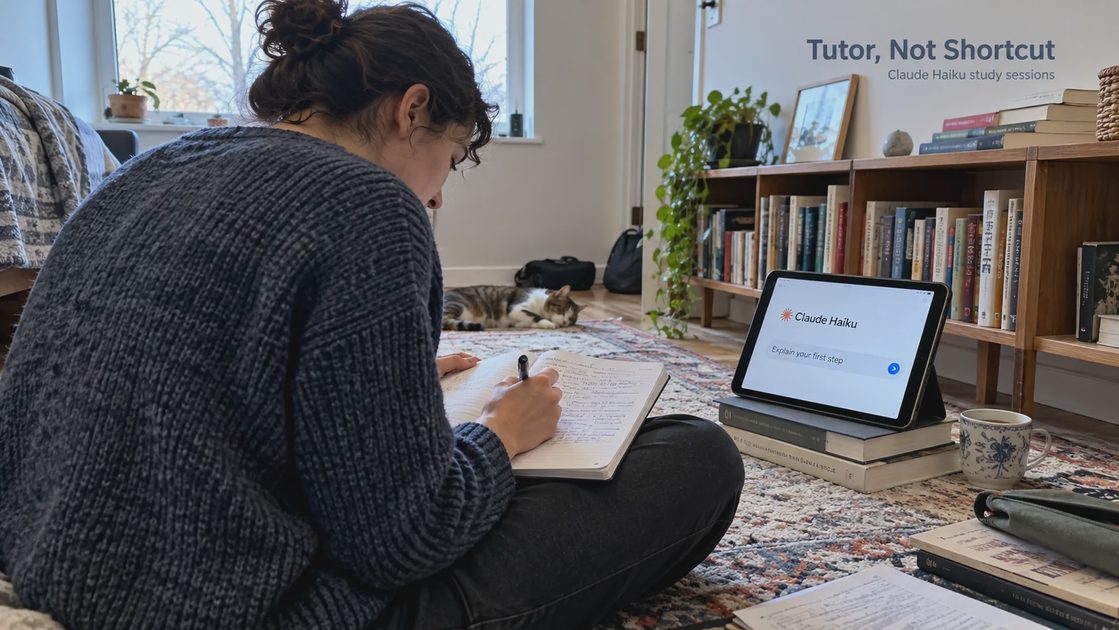
A useful AI study session makes you explain, attempt, and revise. If Claude supplies the answer before you have done the thinking, the conversation may complete the exercise without helping you learn how to complete it yourself.
Use a short cycle: state your learning goal, try a problem, request one hint, attempt again, and test understanding on a new example. Keep course material available to verify explanations and follow the rules that apply to the assignment.
The template below is a proposed workflow, not a completed tutoring trial. It can structure a session with Claude Haiku, but it cannot guarantee accurate feedback or a particular learning outcome.
A Quick Explanation Is Only the Beginning
In my education work, I use Haiku to put difficult paper passages into more accessible language. That can help me return to the original with a better question. It is not proof that I can explain the idea independently or use it in a new situation.
I also learned to keep factual verification separate after a request about a historical figure produced an invented number. A tutoring conversation should therefore distinguish explanation, practice, and evidence checking rather than treating the model as the answer key for all three.
The session template below makes the learner attempt something before receiving a full solution. Keep the source material open, write your own answer, and test it on a different example. When the explanation seems clear, close the chat briefly and try to teach the idea back in your own words.
Decide What You Want to Be Able to Do
Choose an observable goal. “Understand fractions” is broad; “explain why two fractions are equivalent and solve three examples” is easier to assess.
A learning goal should describe your action after the session, not the length of the explanation you want from the model. Reading five paragraphs is not the same as being able to apply a concept.
Write the goal in your own words and note the material you are expected to use. If the course teaches a particular method, provide that method rather than letting the model choose an unrelated shortcut.
Also identify what you already know. A session can waste effort explaining basic terms when the real obstacle is one step in the reasoning.
Set the Tutoring Boundaries
Tell Claude how to interact before supplying the problem. Request one question or hint at a time so you have space to respond.
Help me practice [specific learning goal].
Use the course material I supply as the reference.

Tutoring rules:
Ask one question at a time.
Wait for my attempt before giving feedback.
Do not reveal a complete solution unless I explicitly request it.
Give one hint when I am stuck.
Identify the first reasoning step that needs checking.
Separate source-based explanation from your own examples.
These rules are instructions to inspect, not a guarantee of behavior. If the model gives away the solution, stop reading the answer and choose a different practice item.
Do not include identifying student records or private classroom information. A fictional practice problem is often sufficient for learning how the interaction works.
Begin With a Diagnostic Attempt
Try one representative problem without help. Write enough reasoning that feedback can address the process rather than only the final answer.
For example, if you are comparing fractions, show how you decided which is larger. If you are learning a programming concept, explain what you expect a short snippet to do before running it in an appropriate environment.
The diagnostic attempt is not a judgment of your ability. It identifies where the session should focus.
For learning materials at work, I would want to see the point where a person’s explanation stops making sense. That point is more actionable than a broad statement that the topic is difficult.
Ask the model to identify a question about your reasoning rather than immediately rewriting it correctly. That leaves you responsible for the next step.
Use the Hint Ladder
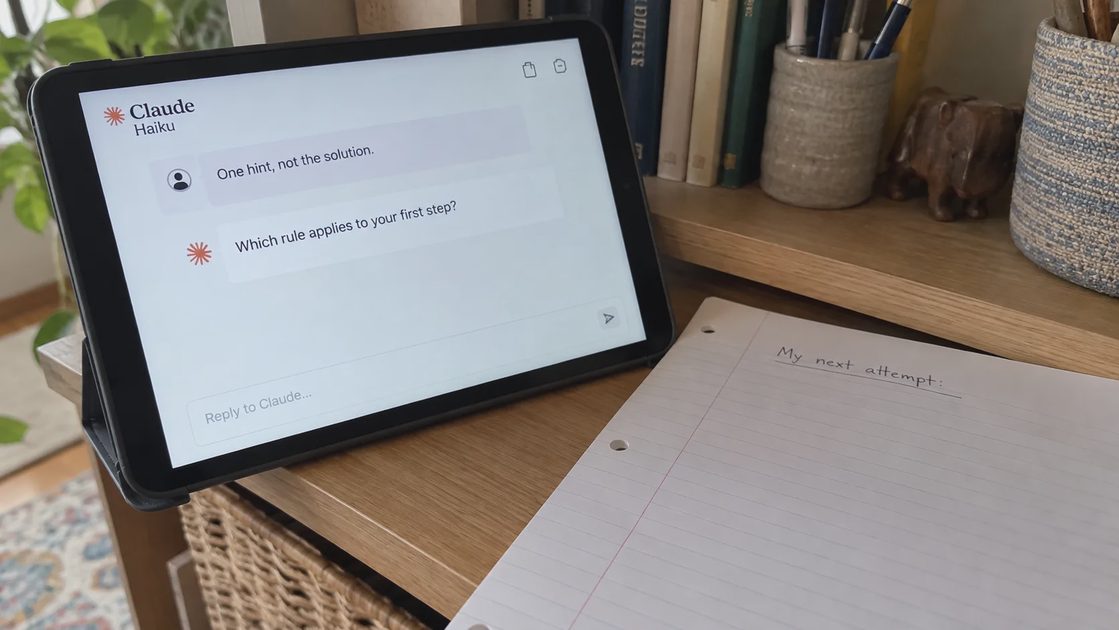
A hint ladder moves from a small cue toward more explicit assistance only when necessary.
Level | Type of help | Your next action |
|---|---|---|
1 | A question about the relevant principle | Name the principle in your own words |
2 | A pointer to the step needing inspection | Try that step again |
3 | A partial worked step | Complete the remaining reasoning |
4 | A full explanation after a genuine attempt | Reconstruct the solution without looking |
You can ask Claude to label which level it is using. The label makes the amount of assistance visible, although you should still inspect whether the response gives away more than requested.
If you need the full explanation, that is not a failure. The important follow-up is to attempt a new problem rather than treat reading the solution as the end of practice.
Ask for Feedback That You Can Use
Useful feedback distinguishes correct reasoning, a specific gap, and the next step. It should avoid both empty praise and unexplained correction.
Evaluate my attempt against the supplied reference.
Tell me:
1. Which reasoning step is supported
2. The first step that is incorrect or unsupported
3. One question that helps me repair it

Do not rewrite the full solution yet.
If the reference does not settle the issue, say so.
Check feedback against the source. If the model claims a rule appears in the material, find it. If a numerical answer is easy to calculate independently, do that calculation.
For an unfamiliar or advanced topic, consider asking a teacher or appropriate expert about a disputed explanation. Model confidence is not a reliable tie-breaker.
Test Transfer With a New Example
After solving the first problem, change one meaningful feature. Use different numbers, a different context, or a case where a condition does not hold.
Do not change every feature at once. A controlled variation makes it easier to identify whether you understand the principle or have memorized the previous steps.
Ask for the new question without its answer. Complete it yourself and explain why the earlier method applies or does not apply.
A model-generated practice item can contain ambiguity or an incorrect answer key. Check whether the item is well-defined before using it to assess yourself. If it is not, revise or discard it.
The point of transfer is to make your own reasoning visible. It is a practical learning check, not a formal measure of mastery.
End With a Teach-Back
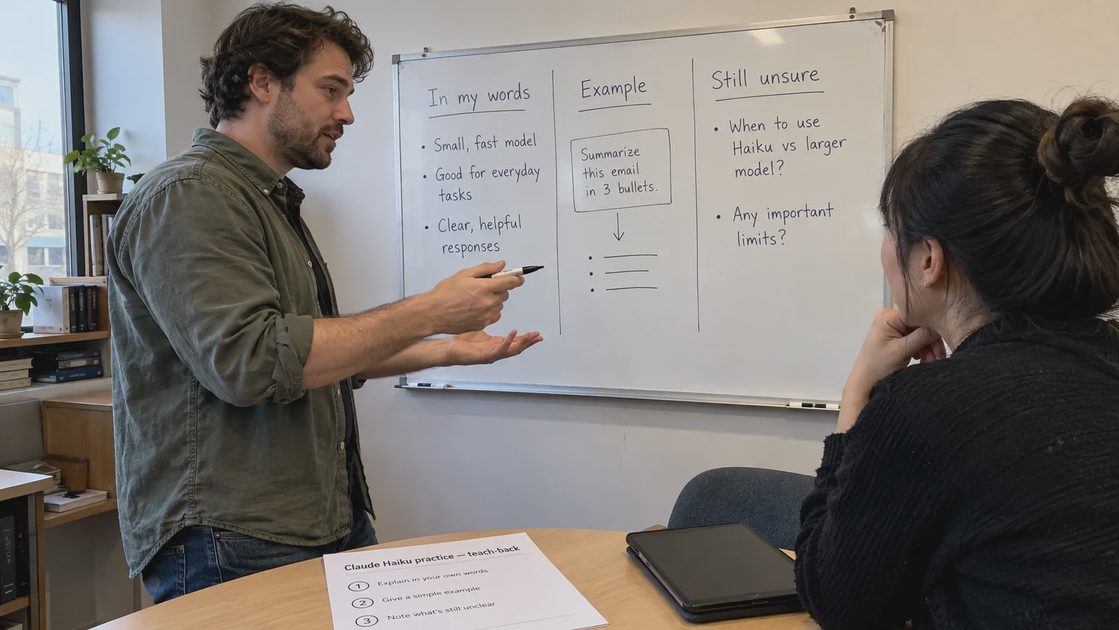
Close the explanations and summarize the concept as if speaking to another beginner. Include a simple example and one boundary or common mistake.
Then ask for a source-based review of your explanation. Again, feedback should identify specific gaps rather than produce a polished replacement paragraph.
Keep the final explanation in your own words. You can edit it after review, but you should be able to explain every sentence without referring to the chat.
I would make this the final artifact of the session: a short learner-written explanation, one solved example, and a question that still needs attention. That is more useful than a long transcript full of answers you recognize but cannot reproduce.
A Reusable Session Record
Use a simple note with these fields:
Goal: what you wanted to be able to do.
Reference: the course material or source used.
First attempt: where the reasoning broke down.
Assistance: which hints were needed.
New example: whether you could apply the idea independently.
Remaining question: what to revisit next time.
The record does not need to assign a score. Its purpose is to show what practice should happen next.
If you study with others, follow the agreed boundaries for sharing questions and answers. Do not use the session template to obtain help that an assessment explicitly forbids.
When I Would Use This—and When I Would Not
I would use Claude for staged hints, practice variations, and feedback on my own explanation when the material can be checked. A session should leave the learner doing more of the reasoning, not less.
I would not rely on its answer key without inspection, submit generated work as independent work, or interpret a smooth conversation as proof of learning.

No letters yet — be the first to write.