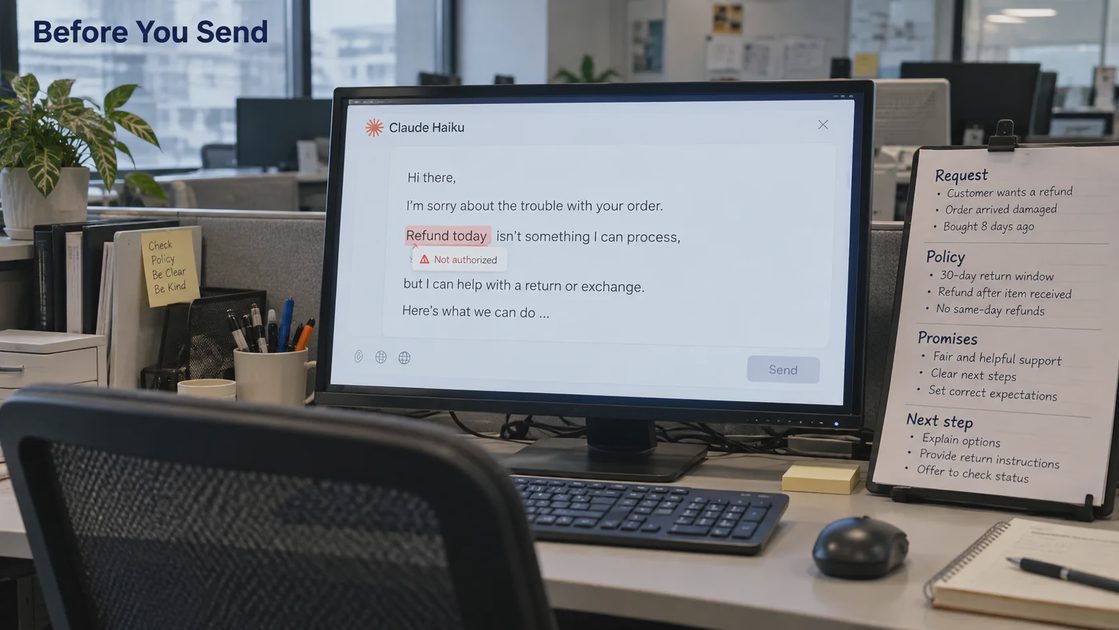
A support draft is ready only when the reviewer has checked the customer’s request, the supporting policy, the proposed commitments, and the actual next action. Correct grammar and a friendly tone are not enough.
Use an AI draft as a starting point, with the original message and approved source material beside it. A reviewer should be able to explain why each important statement is justified before the reply is sent.
This checklist is a proposed editorial and operational aid, not a tested guarantee against support errors. Adapt it to your business’s policies, responsibilities, and risk controls.
The Review Rule We Added for Refund Requests
Our routine learner-support drafts can be straightforward. A dissatisfied learner asking for a refund needs a different level of attention. I have seen Haiku produce stiff, repetitive courtesies that risk making an already frustrated person feel unheard.
Our boundary is that requests involving emotion or money stay with a person. Haiku may help with a draft, but someone must inspect the facts, the applicable policy, the proposed commitment, and the tone before sending anything.
That order matters. Asking for warmer language can improve the surface while leaving an unauthorized promise underneath. The checklist below makes review concrete: identify the unresolved request, trace each material claim to its source, and check what the message says will happen next. When the source or authority is missing, escalate rather than polish.
Why “Human in the Loop” Needs a Definition
A person who glances at a response and clicks send is technically involved, but that does not describe a meaningful review process. The person needs the relevant context, a clear standard, and permission to stop or escalate.
Define who reviews, what they inspect, and what happens when the draft does not meet the standard. If the reviewer must process too many responses to inspect them properly, the workflow design needs attention.
Also distinguish draft approval from action authorization. A well-written explanation does not itself authorize a refund, account change, or exception.
For a small team, I would make these responsibilities visible before comparing model speed. A faster draft is not useful if no one can confidently approve it.
The Checklist at a Glance
Review area | Required question |
|---|---|
Request | Does the draft address what the customer actually asked? |
Facts | Are names, dates, product details, and account facts supported? |
Policy | Does every policy statement match the current approved source? |
Commitment | Does the draft promise only what the team is authorized to do? |
Privacy | Does it disclose only appropriate information? |
Action | Is the next step clear, feasible, and properly authorized? |
Tone | Is the wording respectful and proportionate? |
Escalation | Does uncertainty or an exception need another reviewer? |
Use the table as a navigation aid. The detailed checks below explain what those questions mean in practice.
1. Compare the Reply With the Whole Request
Read the original message, not only the model’s summary. A customer may ask two questions, report a symptom, and state a constraint in the same paragraph.
Check whether the draft addresses the main issue and preserves the constraint. A reply that answers a secondary question while missing the account-access problem can be polished but unhelpful.
If clarification is needed, ask a specific question rather than assuming the missing detail. The reviewer should decide whether it is appropriate to request that information through the available channel.
Do not let the draft repeat the customer’s unsupported claim as a verified account fact. “You report a duplicate charge” differs from “you were charged twice.”
2. Verify Facts and Policy Separately
Factual claims may come from the customer message, verified records, or approved product information. Policy claims should come from the current policy source.
Check each important statement against the appropriate source. A fact about the product does not establish the customer’s account state, and a customer’s description does not establish eligibility under a policy.
If the draft cites an internal document, find the cited section and preserve its conditions. Check that the source is current and applicable to the customer’s situation.
A source reference generated by the model is a candidate to inspect. Its presence alone does not establish support.
3. Inspect Every Promise
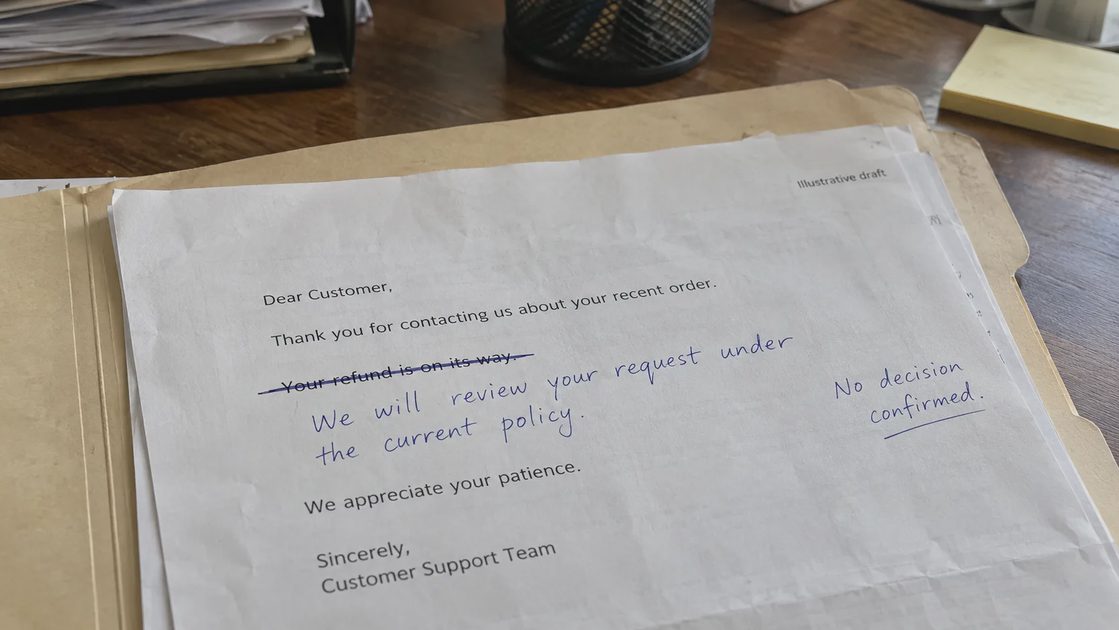
Look for wording such as “we will,” “you can,” “your refund,” “guaranteed,” and specific completion dates. Those phrases can create commitments even when the draft’s overall tone seems cautious.
A fictional example makes the distinction clear: “We can review your request under the refund policy” is different from “Your refund will arrive tomorrow.” The second requires evidence and authorization not supplied by a generic policy summary.
If the team has not made a decision, the draft should not imply it has. Replace unsupported promises with a supported explanation of the next step.
The reviewer also needs to confirm that the next step can actually occur. A friendly commitment to “contact the specialist immediately” is misleading if that route is unavailable.
4. Check Information Exposure
Ensure the draft does not reveal internal notes, other customers’ details, confidential policy deliberations, or unnecessary account information.
Check quoted material carefully. A model may reproduce a private detail from supplied context even when the customer did not need it in the reply.
Use only the information appropriate to the recipient and channel under your procedures. If identity verification is required, follow that process rather than inventing a conversational shortcut.
For draft-only pilots, sanitized examples can reduce exposure while the team learns the review method. They do not eliminate the need for appropriate controls when handling live data.
5. Make the Next Action Clear
The reply should explain what happens next and who is expected to act. Avoid vague statements such as “we will look into it” when the team can provide a more specific, supported process.
If the customer needs to provide information, specify what is needed without asking for inappropriate sensitive data. If the team needs to review internally, say what can be said under the approved process.
Do not combine an explanation with an unapproved action. Sending the message and changing an account are different operations, even if the workflow presents them on one screen.
The final approved reply should match what the team is actually prepared to do.
6. Review Tone After Substance
Once the content is supported, check that the wording is clear, respectful, and suited to the situation. Avoid excessive apology, defensive explanations, or exaggerated empathy that feels disconnected from the request.
Tone should not conceal uncertainty. A calm explanation of what needs checking is better than confident reassurance unsupported by the record.
I would keep the customer’s practical next step prominent. A warm paragraph that leaves someone unsure what to do has not finished the support task.
If a tone edit changes a commitment or policy statement, repeat the factual review of that sentence.
7. Escalate Instead of Forcing Approval
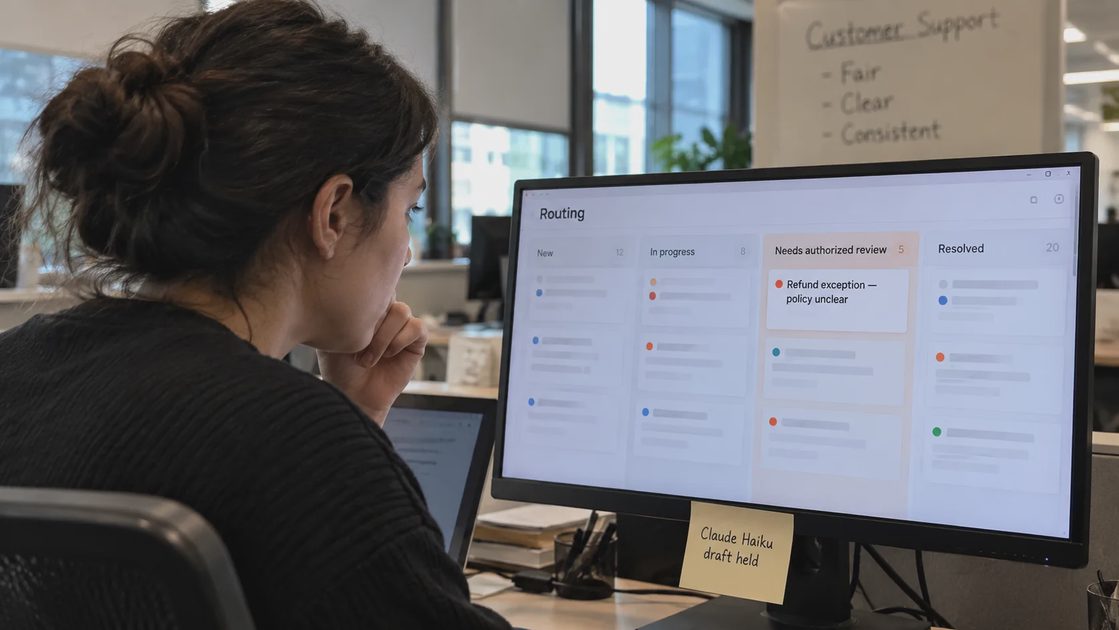
Define which cases require an authorized person: unclear policy, exceptions, disputed facts, unusual account conditions, or consequences beyond the reviewer’s role.
The model can flag a candidate case, but the team’s policy determines escalation. Do not depend exclusively on generated flags to identify important issues.
If review reveals uncertainty that cannot be resolved from available material, pause the response. A draft should not be approved merely to keep the queue moving.
Record why escalation was needed. Those records can identify recurring documentation or workflow gaps.
Keep Corrections Useful
A short correction log can distinguish unsupported promise, missed request, wrong policy, unnecessary disclosure, unclear next step, and tone revision.
Use the log to improve prompts and sources, while retaining human review. If the same correction appears repeatedly, change the workflow rather than expecting reviewers to absorb it indefinitely.
Do not count every edit equally. A comma correction and an unauthorized promise have different consequences. Report the type of work required, not only the number of changes.
When I Would Use This—and When I Would Not
I would use this checklist to review bounded support drafts when the original message, current policy, and appropriate records are available. It also helps define what a draft-only pilot should measure.
I would not treat the checklist as automatic authorization or assume that a person can compensate for unlimited model errors under time pressure.

No letters yet — be the first to write.