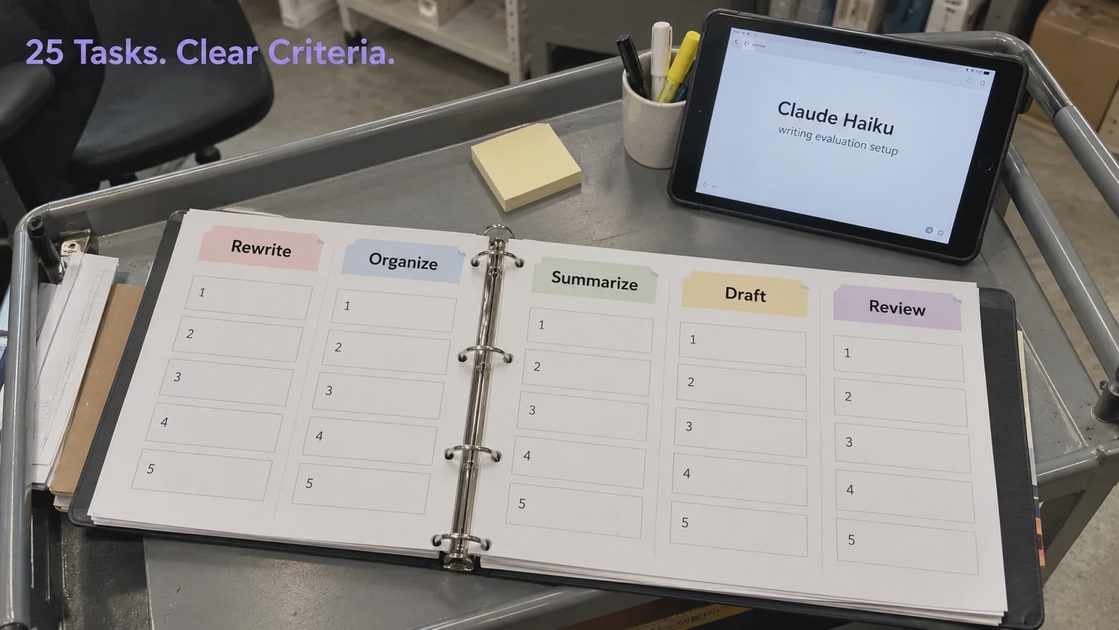
A useful writing evaluation needs more than twenty-five prompts and a collection of impressive answers. Define what each task must preserve, review the outputs against their inputs, and record the corrections required before the text can be used.
The framework below organizes twenty-five proposed tasks into five groups. It is a testing protocol, not a report that Audrey has already completed the runs. The earlier observations below inform the test design; the proposed twenty-five runs have no results yet.
The purpose is to evaluate everyday writing work without confusing fluent prose with accurate, appropriate, and usable content.
What My Existing Trials Suggest Testing
I sometimes try a run of small tasks during a quiet evening because Haiku’s quick responses make experimentation easy. That habit gives me questions for a structured evaluation, not a completed twenty-five-task scorecard.
Our support drafts have exposed stiff courtesy language. Document work has shown me that a broad answer can miss a requested detail, and a historical-number check produced an invented figure. Those observations suggest cases involving tone, coverage, and unsupported claims.
Use them to design checkable inputs. A tone task must preserve the same commitments after revision. A summary task must retain a named condition. A factual task should remain unresolved when its source is absent. The twenty-five tasks below are a proposed test set; their results need to be recorded when they are actually run.
Choose Five Task Families
A balanced set should include different kinds of transformation rather than twenty-five variations of “write an email.” The families below test distinct requirements.
Family | Five proposed tasks |
|---|---|
Rewrite | Shorten an update; simplify an instruction; adjust tone; remove jargon; preserve a deadline while rewriting |
Organize | Create an outline; group notes; identify action items; separate facts from questions; structure a checklist |
Summarize | Summarize a paragraph; condense a meeting note; list caveats; compare two passages; identify unsupported claims |
Draft from sources | Draft an internal update; a parent-facing explanation; a support reply; a content brief; a FAQ answer |
Review | Find ambiguity; inspect promises; check attribution; identify missing information; suggest targeted edits |
Each proposed task needs its own source input and acceptance criteria. The table is a design for evaluation, not evidence of performance.
Select tasks that resemble the work you actually do. A set dominated by playful creative prompts may not answer a question about routine administrative drafts.
Build Inputs With Checkable Details
Use fictional or appropriately sanitized material. Include dates, conditions, dependencies, and missing information when relevant so the review has something concrete to inspect.
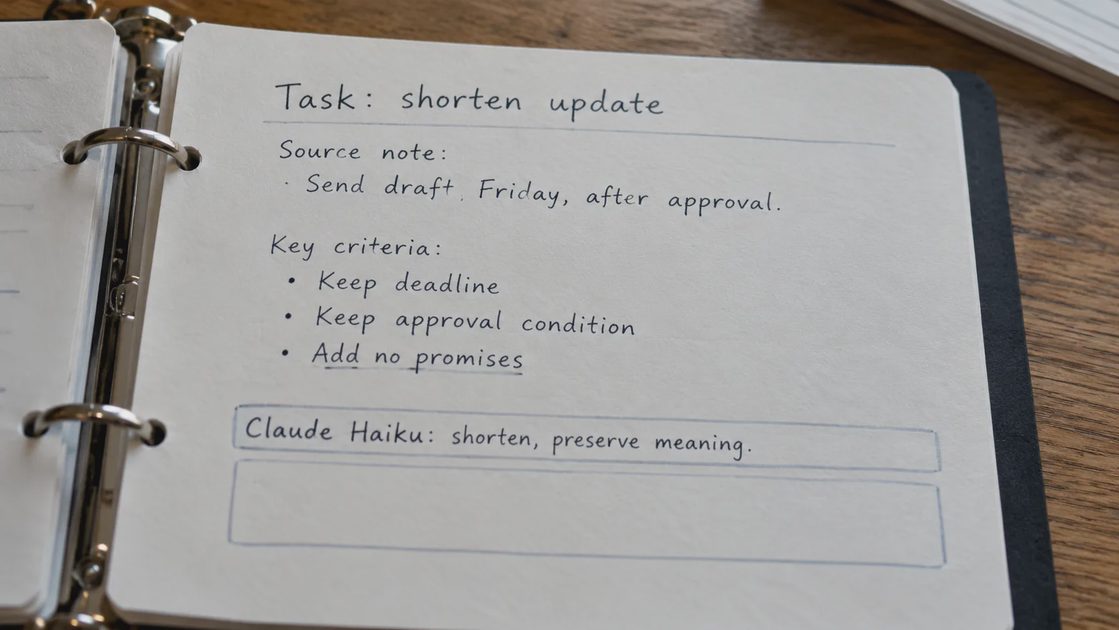
For a rewrite task, a fictional input could say:
Send the draft Friday at 3 p.m. after the introduction is approved. If approval is delayed, contact the editor rather than sending the unapproved version.
A successful rewrite must preserve the date, approval condition, and fallback. A friendlier tone that removes the condition fails a meaningful requirement.
Do not make every input perfectly clean. Include realistic ambiguity, but identify what a correct response should do with it. If information is missing, the accepted output may need to ask a question rather than guess.
Define Task-Specific Acceptance Criteria
Before running the model, write the requirements for each task. Avoid judging every answer by a general impression of quality.
A summary might need to preserve the main claim and limitations. A support reply might need to use only approved policy and make no unauthorized promise. A checklist might need observable completion conditions.
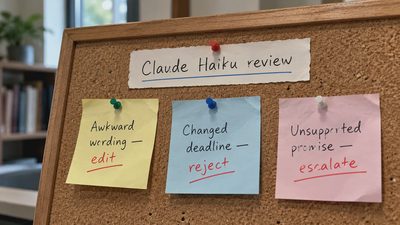
You can use three review outcomes:
Usable after normal review: requirements are met, with no material correction needed.
Needs substantive correction: the draft can be repaired but changes or omissions matter.
Reject or escalate: the result is unsuitable for the task or cannot be verified from the available material.
These are proposed categories. Define them more precisely for your evaluation and do not convert them into numerical claims before actual review.
Keep the Runs Reproducible
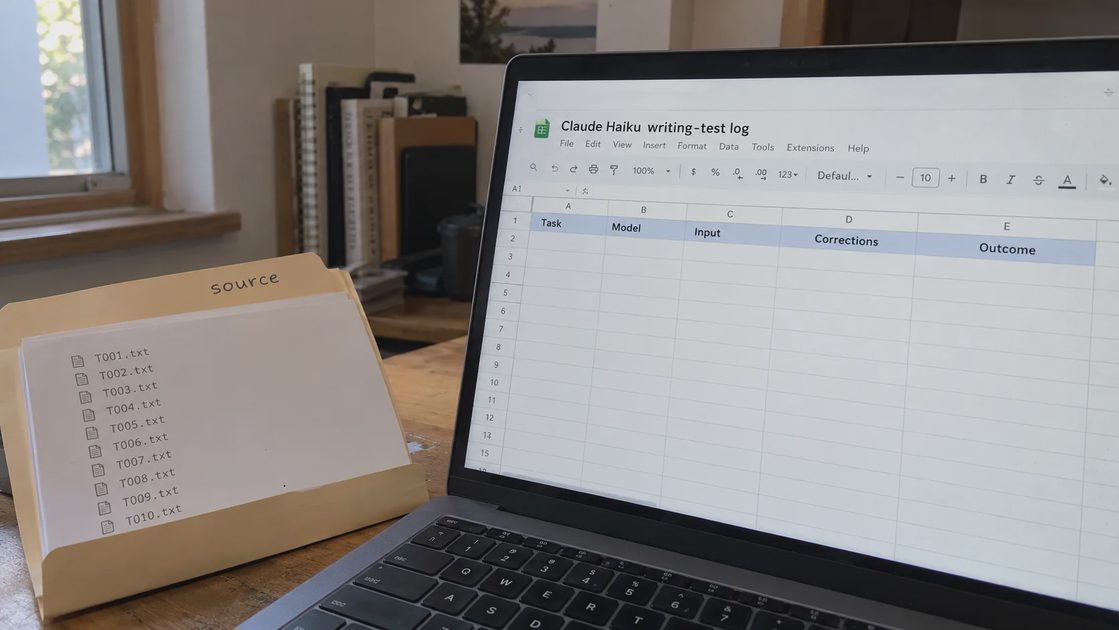
Record the exact model identifier, interface or route, date, prompt, relevant settings, input, and output. Note whether a conversation contains prior context that could influence the answer.
For an initial comparison, use fresh conversations when that is appropriate and keep the instructions consistent. If you revise the prompt after a failure, save the original result and label the revised run separately.
Do not quietly substitute the best response after several attempts and describe it as the first result. Readers need to know whether the workflow required retries.
If you compare another model or a manual baseline, use the same task definition and source material. Differences in the surrounding workflow should be documented.
Review Facts Before Style
Begin with source fidelity: names, dates, quantities, conditions, attributions, and stated uncertainty. Then assess whether the output meets the requested form and audience.
Only after those checks should you judge fluency, tone, and concision. This order prevents pleasant prose from dominating the assessment.
I would want a review note to say why a draft was usable or not. “Too generic” is less helpful than “omitted the approval condition and added an unsupported promise.”
For difficult judgments, a second reviewer can help identify disagreement. Do not treat disagreement as noise to remove; it may reveal that the acceptance criteria need clarification.
Measure the Work After Generation
When timing matters, record preparation, prompting, generation, review, correction, and transfer. Specify whether the clock includes interruptions or only active work.
An everyday-work evaluation can include interruptions, but it should describe how they were handled. Otherwise, a slow run may reflect the work environment rather than the model.
Compare the complete process with a reasonable manual method. If a template already handles the task well, include that alternative.
Avoid claiming time saved from response speed alone. The approved final text is the product the task requires.
Analyze Patterns Without Overgeneralizing
Group substantive corrections by type: changed facts, omitted conditions, unsupported additions, attribution problems, wrong audience, or excessive editing.
Look for patterns within task families. A model may be useful for organization but difficult to use for source-bound support drafting under your particular prompts.
Twenty-five tasks do not establish universal writing quality. They describe performance on a selected set under recorded conditions. The set’s limitations belong in the report.
If you repeat selected tasks, explain how many times and why. Repetition can examine consistency, while varied inputs examine breadth. Neither automatically supplies the other.
What a Responsible Results Article Would Include
A future hands-on report should show the task set, scoring or review definitions, representative outputs, important failures, correction effort, and limits on the conclusion.
If examples are omitted for privacy or length, explain the omission and retain the underlying records appropriately. Do not expose private source material merely to make the report look transparent.
A result such as “useful for this task family under these constraints” is more informative than a broad statement that Haiku is good at writing.
Also separate vendor claims from your findings. Anthropic’s description of Haiku as suited to quick, repetitive work provides context, not your evaluation outcome. Official announcement.
Keep the Evaluation Files Together
Retain the task definitions, inputs, prompts, and review notes as one set. A score without its source material is difficult to inspect later. If privacy prevents public sharing, describe the input conditions honestly and publish only examples you are entitled to disclose.
When I Would Use This—and When I Would Not
I would use this protocol to compare bounded writing workflows and identify what reviewers actually need to correct. The task families make it easier to avoid testing only attractive examples.
I would not publish a first-person “I tested” story without performing the runs, omit unsuccessful attempts, or imply that twenty-five tasks prove reliability for every writing need.
Start by preparing five tasks from one family and verifying the acceptance criteria. Expand to the full set only when the review method is clear.
No letters yet — be the first to write.