
Use Claude to make a difficult article easier to navigate, then return to the article to check what the model says. A useful three-pass method separates orientation, close reading, and synthesis instead of asking for one summary that does everything.
The distinction matters because a clear summary can hide the very qualifications that make the original argument difficult. Your aim is to understand the source, including its uncertainty and disagreement, rather than replace it with smoother prose.
Why I Separate the Three Passes
While working through difficult education papers, I have found Haiku’s accessible wording helpful. I have also seen it produce an invented historical number when asked to verify a citation. Those experiences call for different kinds of trust: help with comprehension can be useful without turning the model into a source of evidence.
The first pass below establishes the shape of the article. The second examines a passage against its actual words. The third belongs to the reader: write what you understand, then check the important claims. Keeping those jobs separate makes it easier to notice when an explanation has wandered beyond the supplied text.
If a passage mentions a study you have not opened, put that study in a follow-up list. Do not ask a smoother summary to stand in for reading the evidence. A question left visible is more useful than a confident answer with no traceable support.
Prepare a Source You Can Refer Back To
Choose an article you are entitled to use and remove sensitive information if necessary. Keep a separate copy of the original so the chat does not become your only reference.
Give the source a stable label, such as Article A. If you divide it into sections, label those sections and retain headings. The label should be your own reference, not a claim that the article has a particular official identifier.
When using excerpts, say that they are excerpts. A model cannot responsibly describe an entire article from a missing middle section or a few selected paragraphs.
For long material, you can work section by section. Record what was supplied in each request and do not assume every interface will preserve the full text indefinitely.
Before prompting, write the question you hope the article answers. That gives the reading a purpose while making it easier to notice when a summary drifts toward an unrelated issue.
Pass One: Build a Map, Not a Verdict
The first pass should identify the argument’s structure: the question, main claim, supporting sections, and important unfamiliar terms.
Use only the article supplied below.
Create a reading map with:
1. The question the article addresses
2. Its main claim, with a supporting short passage
3. The role of each section
4. Terms I may need to understand
5. Questions the article leaves unresolved

Do not evaluate whether the article is correct yet.
If I supplied only an excerpt, limit the map to that excerpt.
A reading map is useful when it tells you where to look. It is less useful when it turns into a general essay on the topic.
Check the main claim against the introduction and conclusion. Those sections may contain important qualifications. If the model states a stronger claim than the author does, revise the map before continuing.
For editorial work, I would prefer a modest map with clear source anchors over a confident account of what an author “really means.” The latter can slip from description into interpretation without making the change visible.
Pass Two: Work Through the Hard Passage
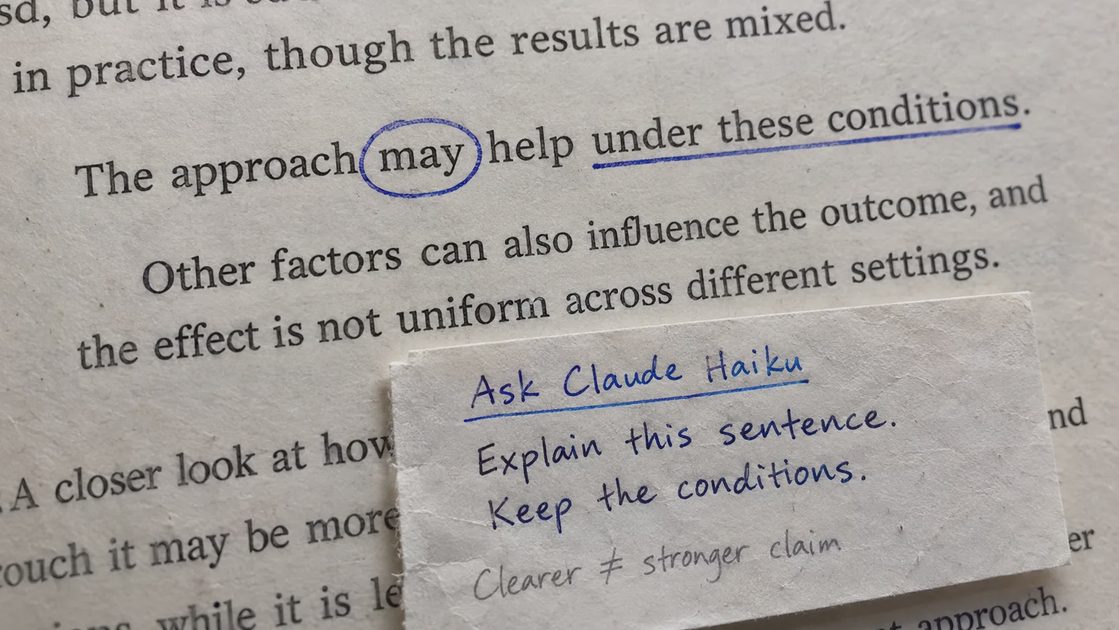
Choose the paragraph or section that remains unclear. Provide the exact text and identify your confusion rather than requesting another full summary.
Here is the passage I do not understand:
[Paste the passage.]

My current interpretation:
[Write a short interpretation.]

Explain each sentence in plainer language.
Preserve conditions, uncertainty, and the author’s distinctions.
Then identify where my interpretation goes beyond the text.
Label your own illustrative examples separately.
This prompt keeps the interaction connected to your reading. It also separates the author’s statements from an example generated to explain them.
Suppose an article says a method can be helpful “under these conditions.” A paraphrase that removes the condition changes the claim. Check terms such as may, often, associated with, and in this sample; they can carry more meaning than the surrounding fluent prose.
A simple explanation should reduce unnecessary complexity while preserving the relationship between claims. If it changes causation into correlation, or the reverse, it has not merely simplified the text.
Use a Passage Review Table
For a difficult section, compare the source and explanation directly:
Source feature | Question to ask |
|---|---|
Conditional phrase | Is the condition still present? |
Qualified claim | Did “may” become “will”? |
Evidence description | Is the sample or context preserved? |
Author’s interpretation | Is it separated from the underlying observation? |
Alternative explanation | Did the paraphrase omit it? |
The table is a reading aid, not a claim that every article contains these features. Use only the rows relevant to your source.
If you cannot judge whether the explanation preserves a technical distinction, consult a suitable reference or knowledgeable person. Asking the model for another confident explanation does not settle the issue.
Pass Three: Write Your Own Synthesis
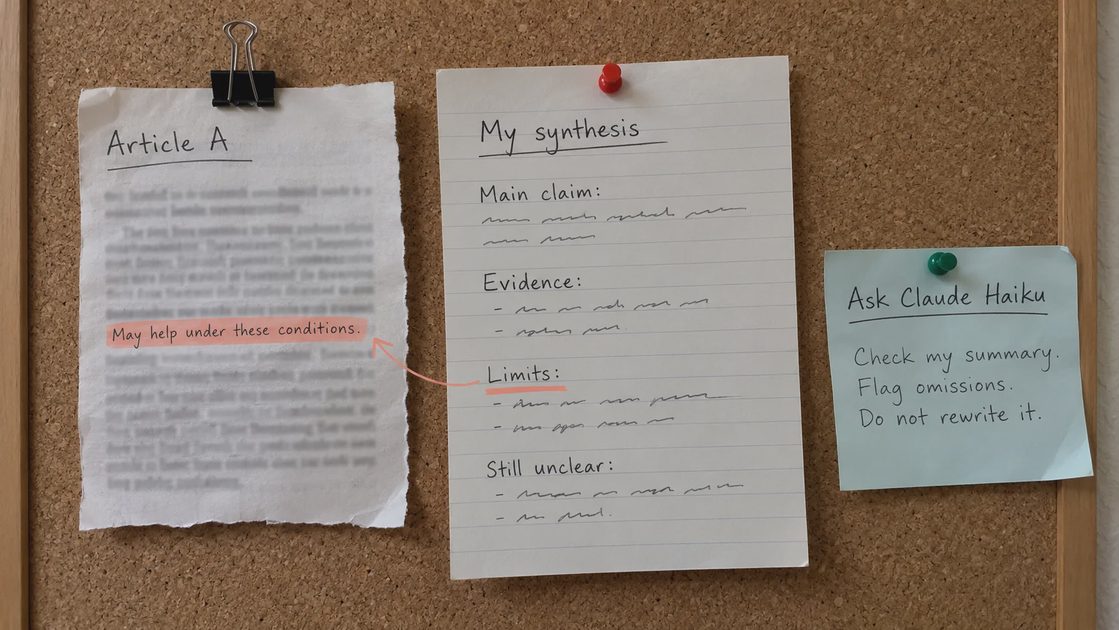
Close the model’s explanation and write a short account in your own words. Include the article’s main claim, why the author supports it, and the limits that matter for your question.
Then use Claude for comparison:
Compare my synthesis with the supplied article.
Do not rewrite it immediately.
List:
- Statements supported by the source
- Important omissions
- Claims stronger than the source permits
- Terms I appear to misunderstand

Point to the relevant supplied passages.
You remain responsible for checking those pointers. A reference to a heading or quotation must actually match the material you supplied.
Revise your synthesis after the comparison. The result should be a piece of understanding you can explain, not a collection of model-generated sentences pasted into your notes.
Decide What Belongs in the Final Notes
A practical final note can have four parts: the question, the article’s answer, supporting passages, and remaining uncertainty. Keep bibliographic details or a source link so you can revisit the original.
Do not mix the author’s claim, your inference, and Claude’s example into one undifferentiated paragraph. Those categories may all be useful, but they do different jobs.
For example, “the article reports X” differs from “I think X implies Y for our situation.” The second may be a reasonable judgment, but it needs its own reasoning.
If the reading feeds into a work document, retain enough source detail for another person to inspect the important claims. A summary without traceability can be difficult to review later.
What to Do When the Three Passes Disagree
The model may describe a main claim in the first pass that the close reading does not support. Treat that as a reason to correct the map, not to force the passage into the earlier interpretation.
Your own synthesis may also identify a question the summary omitted. Return to the source and decide whether the omission matters for the purpose of your reading.
Inconsistency is information about the draft process. It should not be concealed merely to produce a neat final answer.
I would stop using the model for a passage if its explanations repeatedly contradict the text. A narrower question or a human explanation may be more useful than continuing the same interaction.
When This Method Is Too Much
A short, straightforward article may not need three passes. Read it directly and make a few notes. The workflow is most useful when structure, terminology, or qualifications create a genuine obstacle.
Likewise, a summary request is not an adequate substitute for reading material that you must analyze yourself for an assessment. Follow the rules of the course or organization.
When I Would Use This—and When I Would Not
I would use the method for a challenging article whose source remains available and whose important claims can be checked. It is particularly useful when I need to explain the argument to someone else.
I would not rely on it to establish whether unfamiliar technical claims are true, or to summarize an entire document from excerpts while hiding the missing material.
Start with one difficult section. Build a map, inspect the passage, then write your own synthesis.

No letters yet — be the first to write.