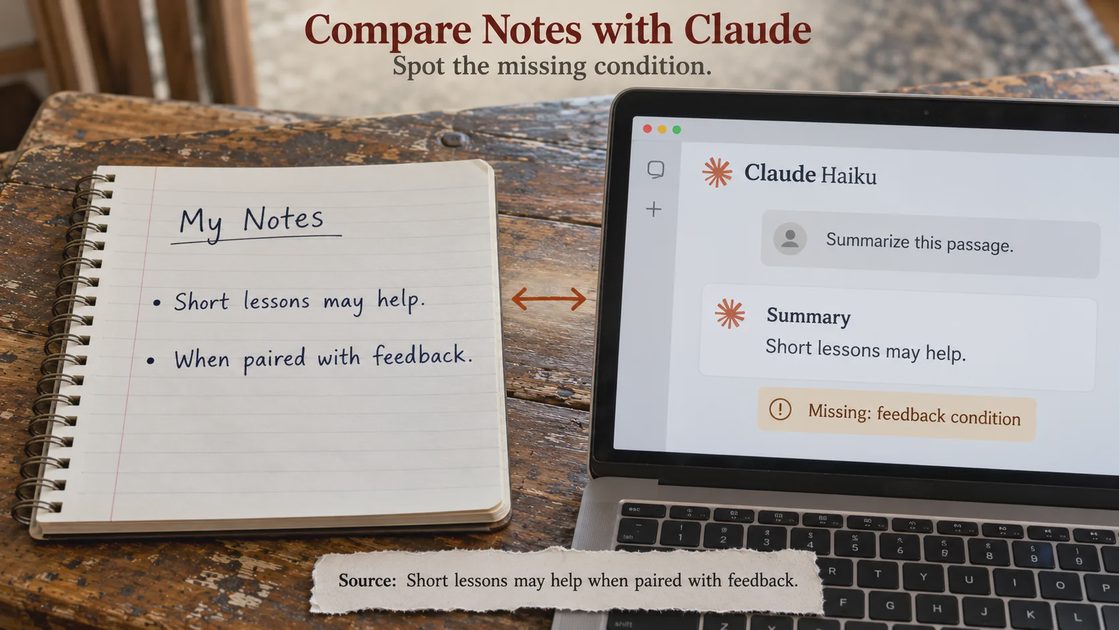
A summary can be accurate sentence by sentence and still leave out the detail you needed. Comparing Claude’s summary with your own notes is a way to inspect coverage, but neither set of notes should automatically become the answer key.
Keep the original source as the authority for what it says. Your notes reveal your reading purpose; the model’s summary offers another selection of the material. The useful work is to examine where those selections differ and why.
The Detail That a Broad Summary Can Miss
I have supplied Haiku with a long internal training document and extended email threads. It can organize the broad content quickly, but a question about a small detail may receive another general summary instead of the detail I need.
My response is to keep the overview and the detail check separate. First ask for the document’s shape. Then ask a narrower question tied to a heading or passage, and inspect that passage myself. This is an observation from my document work, not a scored comparison of every summary against independent notes.
The method below adds that independent comparison. Your own notes help expose what matters to your purpose, while the original document settles what it actually says. If both note sets omit a condition, agreement between them is not evidence of completeness.
Write Your Notes Before Requesting the Summary
Read the source and record its main point, important qualifications, evidence, and unanswered questions. Include a heading, paragraph label, or short passage beside each important note.
Do not aim for perfect notes. The point is to create an independent first selection rather than copy the model’s framing and then compare it with itself.
State the purpose of your reading. A teacher preparing a lesson, a manager making a decision, and a learner seeking background may need different details from the same article.
For education-company materials, I would want to know not only the central argument but also what a reader must not misunderstand. That purpose should influence which omissions matter.
Keep personal reactions separate from source claims. “This seems useful for our course” is your judgment; “the author recommends this for beginners” is a claim to verify in the text.
Request a Summary for the Same Purpose
A fair comparison gives the model the reading objective and the same source material. Otherwise, you might compare your decision-oriented notes with a generic overview and mistake a scope difference for a model error.
Summarize the supplied article for this purpose:
[Describe the reading purpose.]

Include:
- Main claim
- Supporting evidence
- Conditions and limitations
- Unresolved questions relevant to the purpose

Use only the supplied text.
Provide source passages or section references for key claims.
Do not add background knowledge unless separately labeled.
If you supplied an excerpt, record that fact and compare only coverage of the excerpt. Missing material outside the input is not an omission the model could reasonably avoid.
Save the first response before requesting revisions. A comparison becomes hard to interpret if every draft is overwritten and you no longer know which answer was assessed.
Compare Claims, Not Wording
Different phrasing does not necessarily mean different meaning. Break both sets of notes into claims and identify whether each is supported, omitted, changed, or added.
Comparison category | Meaning | Next step |
|---|---|---|
Shared coverage | Both include the same supported point | Check that the wording preserves its scope |
Your notes only | The model does not include your point | Verify the point, then assess its relevance |
Summary only | The model includes a point you missed | Find support in the source |
Changed meaning | Both mention the point differently | Inspect qualifications and relationships |
Unsupported addition | A point lacks support in the supplied text | Remove it or find an appropriate separate source |
This table prevents the exercise from becoming a contest in which either the human or model must win. Both can miss something; both can select differently for legitimate reasons.
A point that appears in only one set is a question to investigate, not an automatic error.
Decide Whether an Omission Matters
Summaries necessarily leave things out. The relevant question is whether the omission changes understanding or prevents the intended task.
Consider three illustrative cases:
A summary leaves out a minor example but preserves the argument. That may be acceptable.
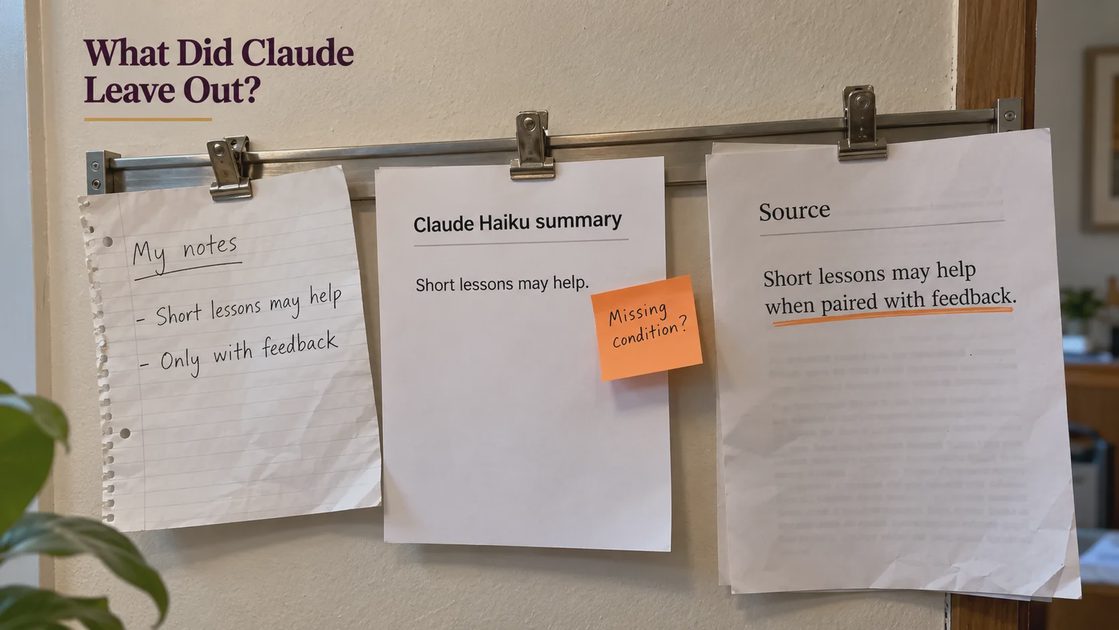
A summary omits the condition under which a recommendation applies. That may change the meaning materially.
A summary omits an exception relevant to the reader’s situation. That can make it unsuitable for the stated purpose.
Mark omissions by consequence rather than simply counting them. Five minor examples may matter less than one missing limitation.
You can ask Claude to help inspect a specific omission, but check the explanation against the source yourself. The same model that produced the summary is not an independent authority on its completeness.
Check Whether Your Notes Overreach
Human notes can contain inferences that felt obvious while reading. The comparison should test those too.
Ask whether you recorded a causal claim where the article described an association, converted a possibility into a recommendation, or treated an example as a universal rule.
If your note is a useful inference, label it as yours and explain the reasoning. Do not force it into the source-summary column merely because you want it included.
I would rather preserve a disagreement between my interpretation and the text than smooth it away prematurely. The disagreement can identify a question worth asking a colleague or teacher.
This is also why a source-based review should keep the original passage accessible. Memory of what an article said is a weaker reference than the article itself.
Request a Revision With Explicit Requirements
After identifying meaningful gaps, ask for a targeted revision. Do not request “a better summary” without naming the problem.
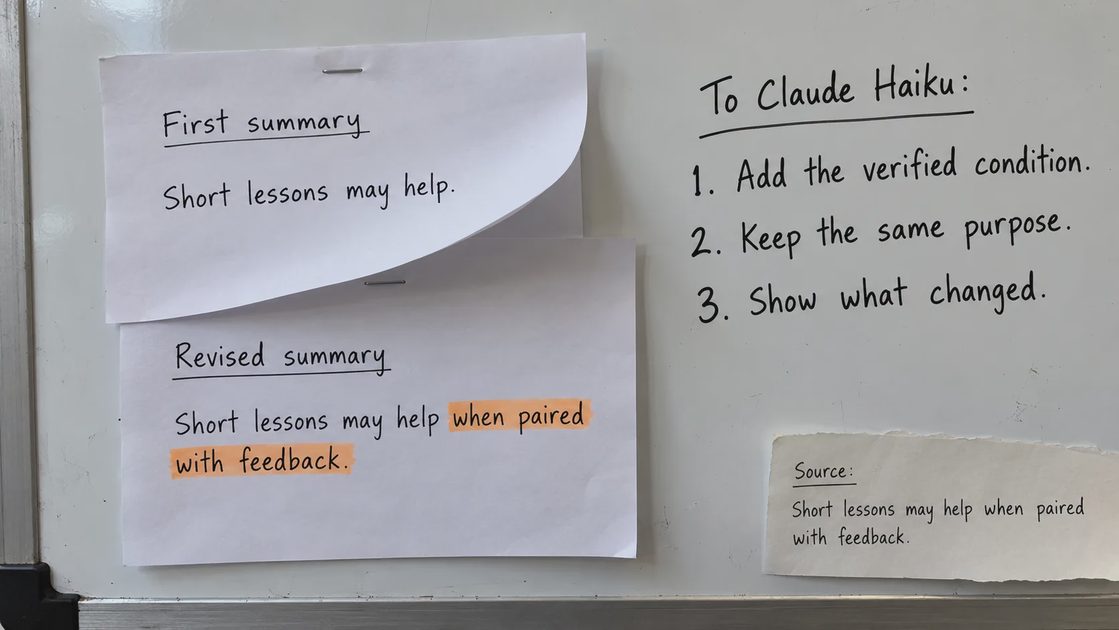
Revise the summary to include these verified points:
[Point and supporting passage.]

Preserve these conditions:
[Relevant qualifications.]

Remove these unsupported additions:
[List them.]

Keep the reading purpose unchanged.
Return the revised summary and a short list of changes.
Review the revision as a new draft. Adding one limitation can accidentally remove another useful point, particularly when you also request a shorter answer.
The change list helps locate edits, but it should not replace reading the revised summary. A model’s account of its own changes may be incomplete.
Keep an Evidence Note, Not a Victory Score
For a small comparison, record the source, reading purpose, prompt, first summary, important differences, and final corrections. If you later evaluate several sources, use the same categories consistently.
Do not present a single source comparison as a general model accuracy score. An article’s structure, your prompt, and the purpose of the summary all affect what the exercise examines.
If you count omissions, explain what counts as one and distinguish significant omissions from optional details. Without that definition, a number can look more precise than the assessment really is.
The most useful outcome may be a stronger final note and a clearer review checklist rather than a claim that a model is broadly good or bad at summarization.
When I Would Use This—and When I Would Not
I would use this comparison when a summary informs a lesson, brief, or decision and the original source is available. It can reveal missing qualifications and improve my own notes at the same time.
I would not use my notes as an unquestioned answer key, count every excluded detail as failure, or publish a retrospective testing story without retaining the actual inputs and outputs.
Choose one short source and one reading purpose. Write your notes first, request the summary second, and use the source to settle differences.


No letters yet — be the first to write.