
A better learning question asks Claude to address the point where your understanding breaks down. “Explain this topic” can produce a broad overview; “I think these two ideas are the same—show me where that reasoning fails” gives the conversation a specific job.
Use Claude Haiku as a practice partner whose explanations you check against your course material or a reliable source. The goal is to improve your own ability to explain and apply the concept, not to collect answers that feel clear while you read them.
Where Explanation Stopped Being Evidence
I use Haiku to unpack difficult passages in education research. Its plain-language explanations can make the next reading step feel manageable. But when I asked it to check a historical figure cited in a paper, it supplied a plausible-looking number that was invented.
That changed the role I give it. Explaining the words in a passage is different from establishing that the passage’s facts are correct. A fluent explanation can help me frame a better question, while the answer to that question still belongs in the cited source.
When asking about a difficult concept, include the relevant passage and request a distinction between what the author states and what Claude adds as an analogy. For a factual question, locate the original evidence separately. “Ask me if you are unsure” is a useful instruction, but it does not make unsupported answers impossible.
Begin With What You Already Think
Before prompting, write a short account of your current understanding. Include the confusing part. That gives you a baseline for noticing what changes after the interaction.
For example:
I understand that a percentage describes part of a whole. I get confused when a price rises by ten percent and then falls by ten percent. I expect it to return to the original price, but my calculation does not.
This is more useful than simply asking for a lesson on percentages. It reveals the misconception: the second percentage applies to a different starting amount.
A source-based learning session should also include the relevant textbook passage or assigned explanation when you are allowed to share it. The model can then work from the material you need to understand rather than selecting a different framing without telling you.
Choose the Kind of Help You Need
Different problems call for different questions. A learner may need a definition, a contrast, a worked example, a hint, or feedback on an attempted explanation.
Where you are stuck | More focused request |
|---|---|
A term is unfamiliar | Define it using the supplied passage and one simple example |
Two concepts seem identical | Compare them and identify the condition that distinguishes them |
A calculation fails | Inspect my steps and locate the first unsupported step |
A passage feels abstract | Connect each claim to a concrete example without adding new claims |
You can recognize but not explain | Ask me to explain it, then identify gaps |
Do not ask for all of these at once. A large response can bury the specific point you need to work on.
In course-production work, I value an explanation that identifies the learner’s next obstacle. For a study session, the same principle means asking for one useful move rather than an entire curriculum.
Ask for a Hint Before a Solution
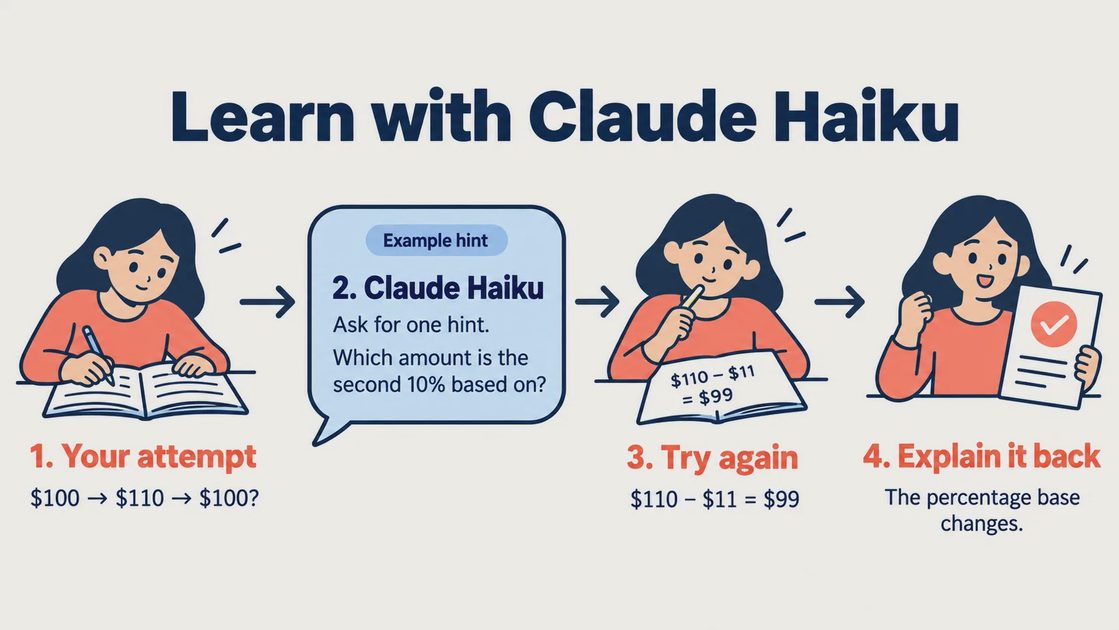
If you are practicing, request a staged response. The first message should help you make another attempt, not complete the exercise for you.
I am learning [topic].
Here is the exercise and my attempt:
[Paste non-sensitive material you are allowed to share.]

Do not give the final answer yet.
Identify the first step where my reasoning needs checking.
Give one hint that helps me try again.
Wait for my revised attempt.
After revising, ask for feedback on the change. If the model jumps straight to the solution, restate the boundary or stop and solve the next step yourself.
This approach keeps the learning activity with you. It also makes it easier to see whether the explanation addresses your actual reasoning or merely repeats a standard answer.
Use a Worked Example You Can Verify
A worked example is useful when each step connects to the previous one. Ask for the principle behind the step, not only the calculation.
For the percentage problem, you can use numbers that are simple to check manually: a starting price of $100, a ten-percent increase to $110, and a ten-percent decrease from $110 to $99.
The arithmetic demonstrates that equal percentage changes in opposite directions do not necessarily cancel because the base changes. You can verify these numbers yourself; you do not need to trust the model’s confidence.
Then request a new example with different numbers and solve it before reading the explanation. Transfer to a new example is a stronger check of understanding than recognizing the original one.
Do not generalize from a correct arithmetic example to trust in every explanation. Each unfamiliar claim still needs an appropriate source or independent check.
Ask for the Boundary of the Explanation
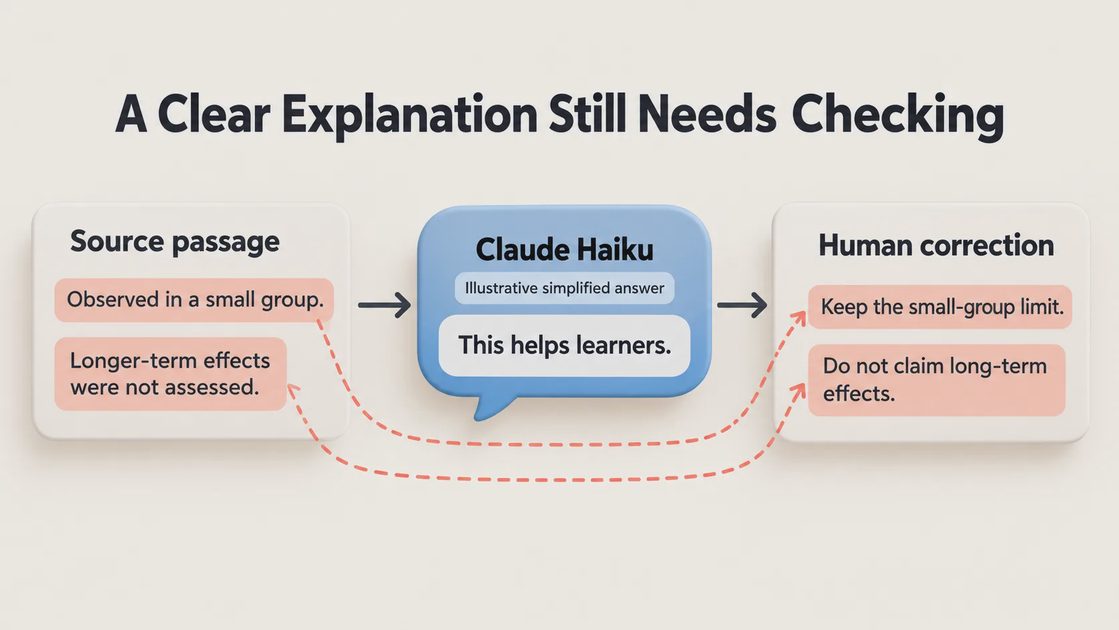
Simple explanations often omit conditions. That can be useful at the beginning, but the simplification should be visible.
Explain this concept using the supplied material.
After the explanation, identify:
- The conditions under which it applies
- One common misunderstanding
- What you simplified for a beginner
- Any claim not supported by the supplied material
A model-generated list of limitations is not proof that all limitations have been captured. Compare it with the source, particularly if the topic involves professional or technical decisions.
For subjects you do not yet understand well enough to verify, use the model to generate questions for a teacher or identify passages to revisit. That can be a useful role without treating it as the final authority.
Turn Recognition Into Recall
An explanation may feel clear because it supplies every connection while you read. Close the answer and try to explain the concept without looking.
You can ask Claude for a short practice sequence:
One question requiring a definition in your own words.
One example requiring application.
One case where the concept does not apply.
One question about a common misconception.
Request questions first and answers separately. If both appear together, copy only the questions into your study notes before attempting them.
Feedback should identify which part of your answer is correct, what is missing, and what source passage you should check. A flattering “great job” is not enough to assess understanding.
Keep a Small Learning Record
A useful session note contains the question you started with, the explanation you can now give, and the uncertainty that remains. Avoid saving long chat transcripts as a substitute for processing the material.
I would keep the learner’s own explanation at the center of the record. The purpose is to make progress visible without confusing generated text with understanding.
If you are studying for a course, follow its rules for AI use. Do not submit a generated solution as your own work or use tutoring prompts to bypass an assessment’s requirements.
Also protect personal information. A learning question usually does not require a student’s name, grade record, private messages, or identifying school details.
Recognize When to Change the Approach
If several answers repeat the same explanation without resolving the confusion, change the representation. Ask for a contrast, a diagram you can check, or an example with simpler numbers.
If the answers contradict the source, return to the source and seek qualified clarification. Asking the model to reassure you is not a verification method.
If the explanation grows more complicated each time, reduce the scope to one claim or one step. A narrower question can make both learning and checking more manageable.
When I Would Use This—and When I Would Not
I would use Claude for hints, practice questions, source-based explanations, and feedback on a learner’s own attempt. The strongest sessions make the learner do something after the explanation.
I would not use it as an unchecked authority, a substitute for course requirements, or a way to generate an answer I cannot explain independently.
Begin with one sentence describing the confusion and one attempt at reasoning through it. That gives the model a specific teaching task and gives you a clear test of whether the help worked.


No letters yet — be the first to write.