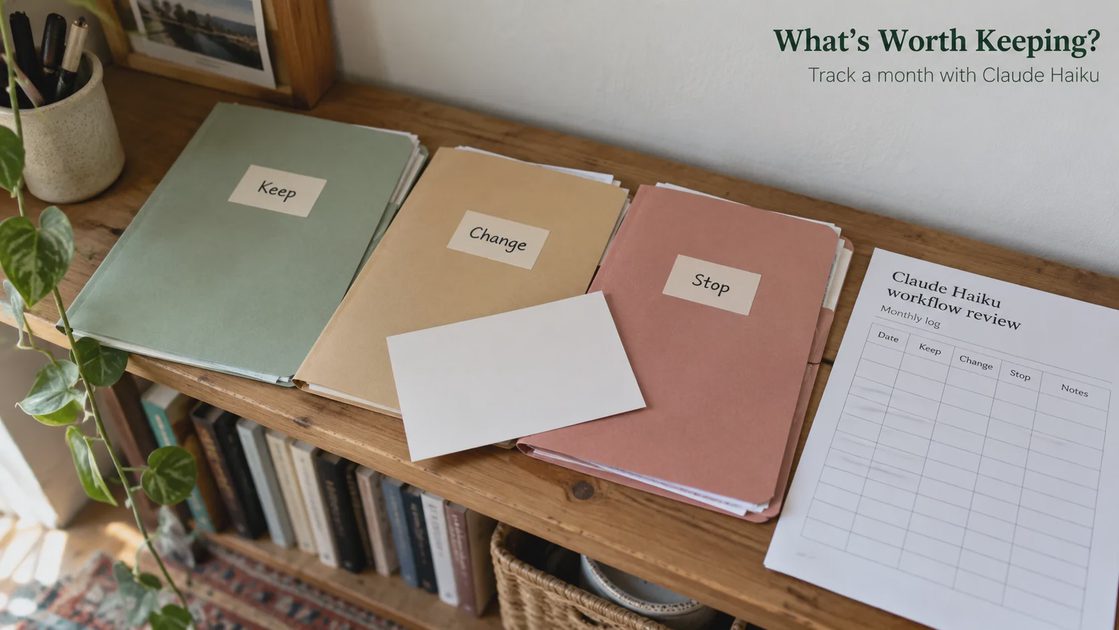
A first-month AI review should identify which workflows earned their place, which required too much correction, and which were never worth adding. Keep a small record of actual tasks and complete effort so the decision rests on observations rather than the most memorable response.
This guide explains how I would log a month of use and decide which workflows to keep. Anthropic announced the model on October 7, 2026; a full month after that release has not elapsed as of this article’s publication. Official launch announcement.
The useful outcome is an informed choice about a few recurring workflows, not a declaration that AI transformed everything.
What I Already Know—and What Still Needs a Log
My early experiences give me a useful starting list: task organization can help, meal ideas still need household constraints, support drafts need tone review, and policy-based documents require a current source pack. I have also seen a factual check produce an invented number.
Those observations do not establish monthly savings or a final adoption decision. A recurring workflow needs a record of what was used, what was changed, and how much complete effort it required. Memorable mistakes are useful examples; they are not the whole denominator.
The month-review method below turns those questions into a manageable log. Keep observations specific to the actual model and date. Earlier Claude experiences can inform the test design, but they should not be silently relabeled as a month of Haiku 5.5 use.
Choose a Small Starting Set
Select two or three recurring tasks you can inspect. For example, organize short notes, draft a source-bound internal update, or prepare a checklist from existing instructions.
Do not evaluate every possible use at once. If the experiment becomes a second job, it may obscure whether the tool reduces the work you originally wanted help with.
Define the baseline for each task: the normal manual process, an existing template, or another established tool. Write what an acceptable final result looks like.
For my own decision-making, I would choose tasks from a friction list rather than novel demonstrations. A recurring annoyance provides a clearer practical question than a one-off impressive output.
Keep a Lightweight Task Log
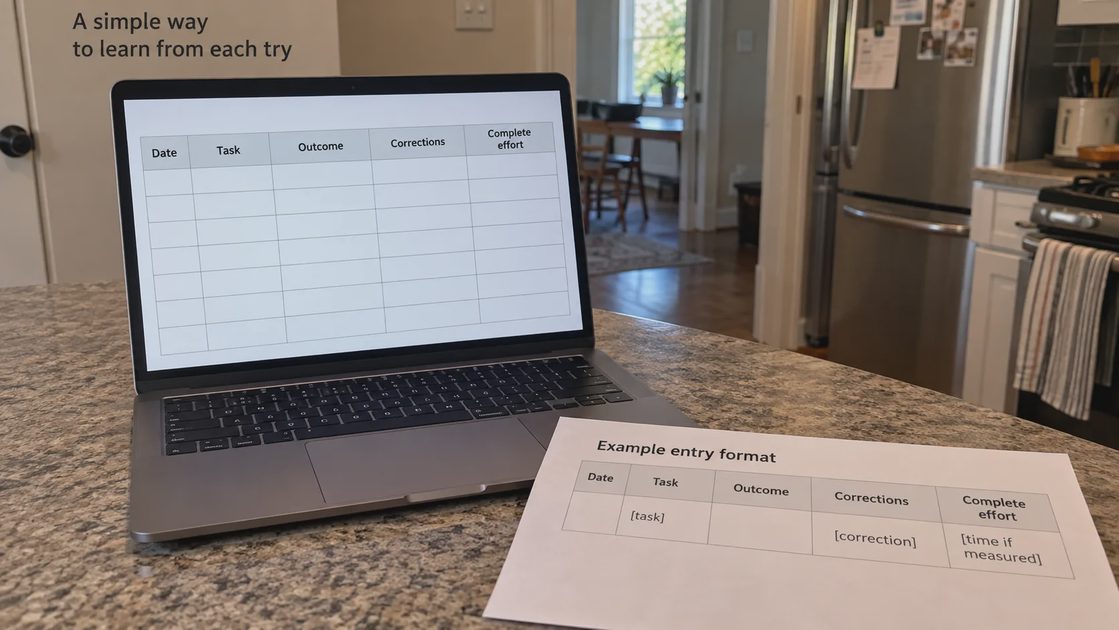
Record only what you need to compare experiences and identify corrections. A simple table is sufficient for many individual experiments.
Field | What to record |
|---|---|
Date and task | Identifies the actual occasion |
Model and route | Records what was used, if verifiable |
Input type | Short note, policy passage, interview notes, or another source |
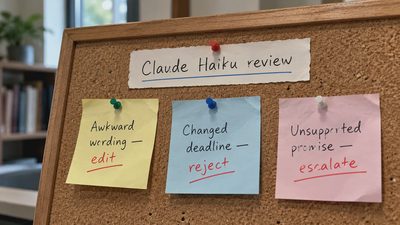
Outcome | Used, revised, rejected, or escalated |
Corrections | Meaningful changes needed before use |
Complete effort | Preparation, prompting, review, repair, and transfer where measured |
Next-use decision | Repeat, narrow, redesign, or stop |
Keep private detail
s out of a public testing record. A task label can describe the type of work without reproducing household, customer, or company information.
If you do not measure time, say so. A qualitative observation about effort is preferable to a precise number reconstructed from memory.
Week One: Establish the Method
Use the first week to learn the prompt and review process. Keep the tasks small, and do not add action-taking integrations.
Record where the instructions were unclear and what facts the reviewer needed to check. Save the original attempts when you change the prompt so the improvement is not confused with first-run performance.
A disappointing output can reveal a poorly defined task rather than an unsuitable model. Clarify the task before making a broad judgment.
At the same time, do not keep redesigning indefinitely to avoid admitting that the workflow may not help. Set a reasonable amount of experimentation for the task’s importance.
Week Two: Repeat on Different Inputs
Apply the same method to new examples from the same task family. This examines whether the workflow is useful beyond the first clean input.
Include ordinary variation: incomplete notes, a longer message, a changed constraint, or a case that should remain unanswered.
Keep the acceptance criteria stable unless you have a reason to revise them. If you change the criteria, document the change and avoid comparing the outcomes as though nothing changed.
Repetition of one input and variation across inputs answer different questions. Use both deliberately if they matter to the decision.
Week Three: Inspect the Handoff and Maintenance
Look beyond the generated answer. Is the approved result reaching the right destination? Does it fit the system you already use? Has a source document or policy changed?
A workflow can be useful in the chat but awkward in daily work. Copying between tools, maintaining separate lists, or revising an old prompt can create hidden effort.
For a small team, ask whether someone else can understand the process and handle a routine exception. A method that only its creator can operate may not be ready to share.
Keep responsibilities explicit: who owns the prompt, who updates sources, and who reviews outputs. Even an informal pilot benefits from clear ownership.
Week Four: Make a Keep, Change, or Stop Decision
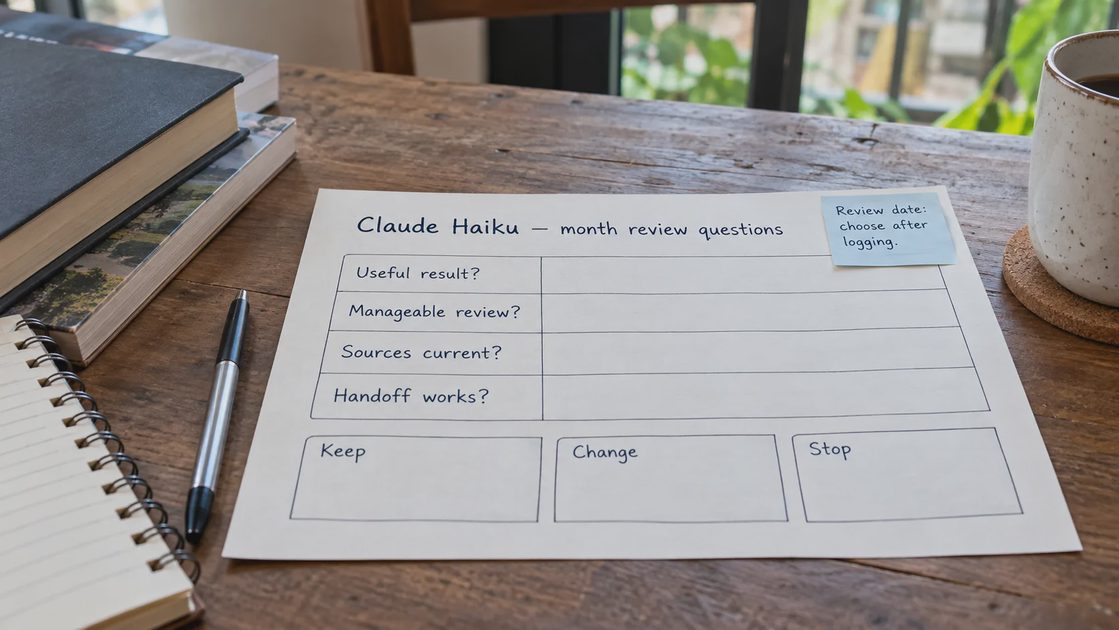
Review the log by task family rather than relying on one overall impression. A model may help with organization while requiring too much repair for another kind of work.
Use three practical decisions:
Keep: the reviewed result is useful and the complete process is manageable.
Change: the idea helps, but scope, sources, instructions, or handoff need revision.
Stop: the benefit does not justify the effort, or important requirements remain unmet.
Stopping is a useful outcome. A template or manual process may be the better tool for a particular task.
Do not treat an adoption decision as permanent. Record the boundary and when you will revisit it.
Evaluate Time Saved Without Inventing It
If you measured both the AI workflow and a reasonable baseline, explain what the timing included and how many occasions were observed.
Do not count generation speed as total savings. Review, correction, source preparation, and transfer can offset the apparent gain.
If tasks differ substantially, avoid aggregating them into a headline number without explaining the comparison. A simple note that one workflow needed fewer steps may be more interpretable than a mixed monthly total.
Also distinguish active work from elapsed time. Family interruptions or other responsibilities can change elapsed time without changing the model’s performance.
I would prefer an honest account of what became easier to a savings figure that cannot be reconstructed from records.
Notice Costs Beyond the Bill
Model usage or subscription cost is one component. Setup, training, review, and maintaining instructions all consume resources.
A low-cost model can make experimentation easier, but the experiment still needs a useful task and an acceptable outcome.
For shared work, include the time another person spends checking or fixing the draft. Otherwise, a workflow may appear to save effort for its user by transferring work to a colleague.
If you estimate future cost, identify assumptions about volume and usage. Keep estimates separate from observed spending and recorded labor.
Write a Review Someone Else Can Understand
A responsible month-review article should state the period, model and settings, tasks attempted, source conditions, acceptance criteria, corrections, and what was kept or stopped.
Use specific examples when records and permissions allow. Do not turn a proposed workflow into a first-person success story merely because it matches the author’s background.
Explain limits. A month of individual use does not establish enterprise reliability, and a small pilot does not represent every reader’s tasks.
The most useful conclusion identifies where the workflow fits and why, with enough detail for another person to try the method responsibly.
When I Would Use This—and When I Would Not
I would use this review method to decide whether a small set of recurring Haiku workflows deserves continued use. The log makes corrections and maintenance visible alongside useful outputs.
I would not publish a completed month review before the period has elapsed, invent savings, or generalize a few memorable responses into a universal recommendation.
No letters yet — be the first to write.